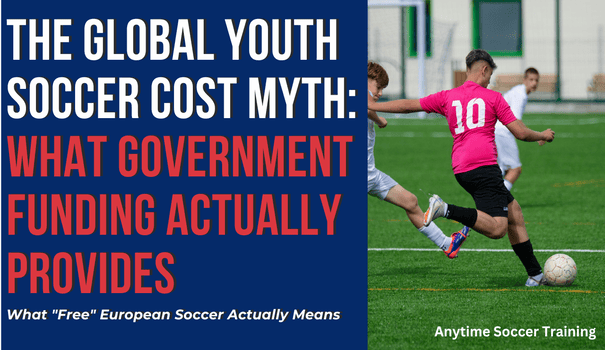
The Global Youth Soccer Cost Myth: What You Actually Get (and Don't Get) When "Government Funds Football"
You've heard it before: "Competitive soccer in the US is expensive, unlike competitive soccer in the rest of the world." It's become gospel in American youth soccer circles.
Someone posts about paying $5,000 for ECNL, and the replies flood in: "In Germany, it costs €150 a year." "In England, grassroots football is basically free." "Hungary's government funds everything through their TAO program."
These statements aren't wrong, exactly. But they're missing something critical—something that changes the entire conversation about what's actually possible for your kid.
🎧 Listen to the Full Discussion
Want to hear more about this topic? Listen to the complete conversation on The Inside Scoop podcast where we dive deeper into the economics of youth soccer globally and what it means for American families.
Here's what I've come to understand after years of researching this, coaching, and watching my own sons come up through the system at both MLS academies and ECNL programs. I want to fact-check my own assumptions and invite correction where I'm wrong.
My Understanding (Please Correct Me If I'm Wrong)
If I still lived in London where my sons were born, my 12-year-old—who currently plays ECNL—would be playing for a grassroots club on a team coached by me, another parent, or a volunteer coach seeking a license and an academy job.
If I wanted him to get a little more than what I could offer, there are clubs with better coaching. But those coaches are paid small stipends, nothing compared to the US. Most are still volunteers.
I could also sign him up for a second grassroots club for an additional day of training. There are some academies that offer "development center" training. And of course, there are private sessions—which would be beyond my budget.
My older son, who's currently at a pro academy in the US, would likely make at least a semi-pro academy in the UK. But before that? He'd be on the local grassroots team coached by another parent, me, or a volunteer coach seeking a license and an academy job.
Some of the more affluent areas may have slightly higher fees for better coaching, but again, nothing like the US.
❌ What I Don't Think Exists There
The option to "pay" for ECNL/MLS NEXT style programming—4 days per week training, two paid coaches, access to regional and national leagues against teams with the same level of programming for 10 months.
From what I understand, that's not really a thing in most of the world. It's counter-cultural because football everywhere else is a working-class sport.
The key difference? Everyone except the top 2-5% playing academy football is playing grassroots. So grassroots can be at a very high level.
And while I'm "just a parent coach," by the time my younger son turned 12, I would have gained over 12 years of coaching experience. The parent coaches aren't particularly good at first—just like rec coaches in the US. You learn over time. Same goes for those volunteer coaches working toward their licenses.
What People Miss About Price vs. Quality
⚠️ Critical Distinction
We cannot confuse price with quality. One program can be expensive and terrible—or expensive and great. The volunteer-based grassroots program can absolutely be better than the expensive pay-to-play option.
So when you see "the government is funding this and that" in other countries, they're funding volunteer-based grassroots football—not the ECNL/MLS NEXT model we have here.
This is not a moral judgment: This article is not arguing that coaches should or shouldn't be paid, or that one system is inherently better than another. It's simply explaining what actually exists in different countries so families can make informed comparisons. The goal is clarity, not advocacy for any particular model.
Another misunderstanding: while macro issues like a closed league system definitely help inflate prices in the US (as discussed in our complete guide to U.S. youth soccer structure), there is a demand for paid services that doesn't exist in most countries at this level.
The Country-by-Country Reality
⚠️ Important Disclaimer
What follows is a generalization based on the most common pathways in each country. Every country has exceptions and variations. Italy and Portugal, for example, have more developed paid middle tiers than England or Germany. Some European countries offer paid semi-professional academies between grassroots and elite levels. However, even where these exist, they don't approach the scale, accessibility, or structure of the US pay-to-play system that has become the dominant competitive pathway.
Let me walk through what actually exists in each country, what you get, and what you don't get.
England: The Grassroots Football Reality
What Parents Pay at Grassroots Clubs
Grassroots youth football in England runs approximately £185-275 per season for registration fees. One club advertises this works out to roughly £5 per week for training and matches combined. That covers FA affiliation, league fees, kit, and access to facilities.
Clubs operate on volunteer labor. A large club may need to find over £10,000 per year just to get all their teams playing regularly—and most of that cash is generated by goodwill and increasingly stretched parents. Pitch fees alone run £500-1,000+ per year per team.
| What You Get | What You Don't Get |
|---|---|
|
|
The pathway to professional football in England runs through the Category 1-3 academy system attached to professional clubs. These academies are free to attend—clubs fund them as investment in future talent. But you must be scouted or trialed. Entry is highly competitive, and most players are recruited between ages 8-16.
🎯 The Gap
There's no paid middle tier between £275/year grassroots and free-but-selective academy football. If your kid doesn't make an academy, they're in grassroots with volunteer coaches—period.
Germany: Club Membership and the DFB System
What Parents Pay
German sports club membership runs approximately €150 per year. At the amateur Kreisliga level (8th-9th tier), players receive no compensation beyond expense reimbursement capped at €250 per month—ensuring the amateur status of the leagues.
Clubs often serve as community hubs offering multiple sports. There are over 87,000 clubs affiliated with the German Sports Federation.
| What You Get | What You Don't Get |
|---|---|
|
|
The DFB Talent Development Programme adds a parallel layer: approximately 1,200 federation-employed coaches work at 390 regional talent centers, serving around 22,000 children ages 11-14 annually. But this is supplemental—kids attend 1-2x per week in addition to their regular club. It's a scouting and identification program, not a replacement for club play. The best players get funneled into Bundesliga academies.
🎯 The Gap
Same as England. No paid-for intensive programming exists between €150/year club membership and free-but-selective professional academy pathways.
Spain: Amateur Clubs vs. Professional Academies
What Parents Pay
Amateur community clubs run €40-80 per month (roughly €500-1,000/year), with training 2-3x per week plus weekend matches. Professional youth academies affiliated with La Liga clubs cost €150-300 per month.
At the higher end, one parent reported their 15-year-old training with Atlético Madrid's B team pays over €400 monthly, with total annual costs reaching €8,000-10,000 including competitions and camps.
| Level | What You Get | What You Don't Get |
|---|---|---|
| Amateur Level | Training 2-3x/week, weekend matches, quality varies widely—some coaches have basic qualifications, mainly supervising kids playing for fun | Professional coaching at amateur level |
| Professional Academy | Training 4-5x/week, regional/national competition, professional coaching, clear pathway to B teams in lower professional divisions | N/A - This is elite programming |
🎯 The Difference from the US
Spanish professional clubs fund their academies as investment in future players—not as revenue centers. They're looking for the next Pedri or Gavi. This means elite academy costs (€2,000-4,000/year) are roughly half of US ECNL fees, even though there's no special government program.
The gap: Still exists. If you don't make a La Liga academy, you're in amateur football with variable coaching quality. Spain just has lower costs at both levels due to club subsidization.
Hungary: The TAO Model Explained
Hungary gets cited frequently because of its TAO (társasági adó) corporate tax redirection program—a unique EU-approved scheme where companies redirect corporate tax payments directly to approved sports organizations instead of the state budget.
What TAO Actually Funds
| What TAO Funds | What TAO Does NOT Fund |
|---|---|
|
|
⚠️ The Critical Number
Hungary has approximately 300,000 registered youth players. Of those, roughly 1,200-1,800 play in TAO-funded academies.
That's 0.5-0.6% of registered players.
The academies are attached to professional clubs (NB I and NB II divisions). 10-12 major TAO-funded academies exist, each serving 150-200 total players across 8-10 age groups. Players must trial and be selected—highly competitive entry, often starting at age 8.
| Academy Players (0.5%) | Everyone Else (99.5%) |
|---|---|
|
|
🎯 The Gap
TAO funds selection, not access. It professionalizes the pathway between grassroots and professional clubs—but only for the tiny percentage who make academy teams. Everyone else experiences volunteer coaching regardless of the funding model.
If my 12-year-old were in Hungary and didn't make an academy, he'd be in a local club with volunteer coaches. Just like in the US.
France: Pôles Espoirs and Clairefontaine
What Exists
The French Football Federation (FFF) operates 15 Pôles Espoirs for boys and 8 for girls, plus the elite Clairefontaine academy that selects just 23 players annually (ages 13-15). All costs are borne by the federation and Ligue Nationale de Football.
Over 300 technical consultants implement regional scouting. This is federally-funded talent identification and development.
| If Selected | If Not Selected |
|---|---|
|
|
🎯 The Gap
Identical pattern. No paid-for intensive middle tier.
Netherlands: High Density, Club Culture
What Parents Pay
Club membership runs €58-180 per year depending on age group. One parent described an amateur club with 80 teams and 1,000+ members, featuring a cooperation agreement with an Eredivisie club.
Due to high population density and short distances, kids often bike to training independently by age 7-8.
| What You Get | The Gap |
|---|---|
|
Same pattern. Professional academies (Ajax, PSV, Feyenoord) are free but selective. |
Brazil: Categorias de Base and Street Football
What Exists
Brazil's professional clubs operate extensive youth academies called categorias de base. These are the lifeblood of the country's talent pipeline—clubs like Flamengo, São Paulo, and Internacional run comprehensive youth systems from pre-childhood through U-23.
Scouts and coaches monitor players at various age groups. The most promising prospects get fast-tracked into professional development programs. Players can receive professional contracts as young as 16-17.
| If Selected | If Not Selected |
|---|---|
|
|
🎯 The Gap
Same fundamental structure. The famous Brazilian development model—with its emphasis on creativity, futsal, and small-sided games—happens largely through informal play and professional academy selection, not a paid middle tier.
Argentina: Baby Fútbol and the Unique Dual Pathway
What Exists
Argentina's baby fútbol system is a unique grassroots phenomenon. In Buenos Aires alone, the FAFI league has 160 teams per age group from U6-U14. That's approximately 840 U11 teams playing every Saturday, representing over 10,000 players at just one age group in one city.
Baby fútbol is 5v5 small-sided football played in restricted spaces. Clubs like Parque Chas have produced over 150 professional players, including Lavezzi, Saviola, Lamela, Crespo, and Zabaletta.
🎯 The Unique Model
Young players who sign with professional clubs (River Plate, Independiente, San Lorenzo) continue training at baby fútbol clubs twice per week in addition to their professional academy training. They play for their baby fútbol club on Saturdays and their academy on Sundays.
What you get:
- Intense small-sided competition from a young age
- Deep community integration
- Parallel pathways (baby fútbol + academy simultaneously)
- Working-class accessibility
The gap: Even in Argentina's famously productive system, the intensive development pathway runs through free-but-selective academy systems. You still cannot purchase intensive professional programming outside academy selection.
The Global Pattern: Side-by-Side Comparison
Here's what emerges across every country:
| Country | Grassroots Cost | What Grassroots Includes | Elite Pathway Cost | Elite Selection |
|---|---|---|---|---|
| England | £185-275/year | 1-2x/week, volunteer coaches | Free | Trial/scouted |
| Germany | ~€150/year | 2-3x/week, club membership | Free | Trial/scouted |
| Spain | €500-1,000/year | 2-3x/week, variable coaching | €2,000-4,000/year (subsidized) | Trial/application |
| Hungary | Near-free | 1-2x/week, volunteers | Free (TAO-funded) | Trial/scouted |
| France | Varies | Standard grassroots | Free | Trial/scouted |
| Netherlands | €58-180/year | 2-3x/week, club system | Free | Trial/scouted |
| Brazil | Varies | Informal + clubs | Free | Trial/scouted |
| Argentina | Low cost | Baby fútbol + clubs | Free | Trial/scouted |
| USA | $150-300/year (rec) | 1-2x/week, volunteers | $3,000-10,000/year | Pay-to-play |
⚠️ The Fundamental Difference
The fundamental difference isn't that other countries have figured out how to make elite development cheap. It's that no other country has a paid-for intensive middle tier at the scale of the US.
Everywhere else, you're either: (1) In grassroots with volunteer coaches, or (2) Selected into a free academy funded by clubs, federations, or (in Hungary's case) redirected corporate taxes. The US is the only place where you can pay for intensive programming without being selected by a professional club.
Important note: This is a generalization. Countries like Italy and Portugal have more developed paid middle tiers than places like England or Germany. Some European countries do have paid semi-professional academies and development programs between grassroots and elite levels. However, even in these cases, the scale, accessibility, and cost structure doesn't match what exists in the US, where pay-to-play programming serving tens of thousands of players has become the dominant pathway for competitive youth soccer.
What Government Funding Actually Does (and Doesn't Do)
When you hear "the government funds youth football in [country]," they're typically funding specific things—and notably NOT funding others.
| What Gets Funded | What Doesn't Get Funded |
|---|---|
|
|
The funding creates a parallel elite pathway that runs alongside volunteer-based grassroots football. It doesn't replace grassroots with professional coaching for everyone.
Understanding how this connects to the broader U.S. youth soccer structure helps clarify why American costs are higher—and what would need to change to bend the cost curve.
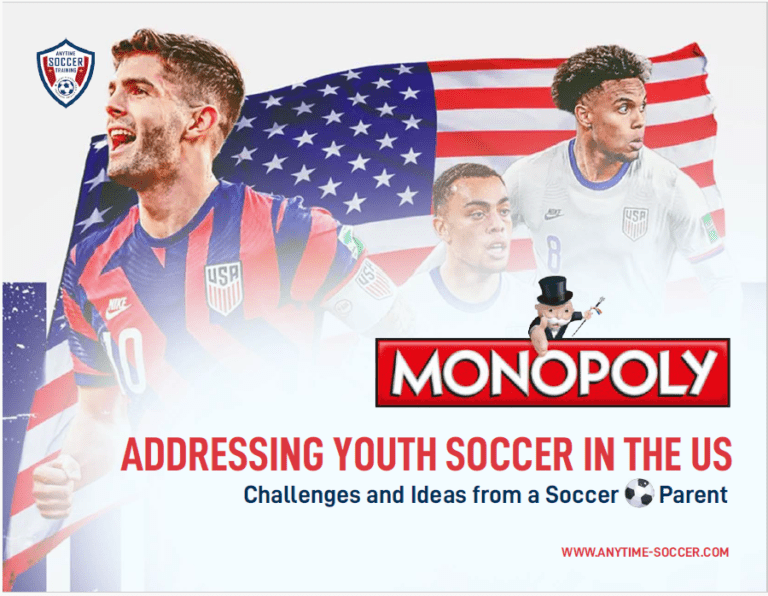
📖 Understanding the US System
Learn why the US youth soccer structure drives higher costs: Download Free Ebook - Monopoly: Addressing Issues Facing Youth Soccer
What This Means for US Parents
The Honest Trade-Off
In the US, you can purchase something that doesn't exist elsewhere: intensive professional coaching, 4+ days per week, 10-month seasons, regional/national competition—all without being selected by a professional club.
ECNL and MLS NEXT are essentially a privatized version of what professional club academies provide in Europe, funded by parent fees instead of club operations or tax policy.
🎯 Important Clarification: MLS Academies Are Free
Just like European professional academies, MLS club academies are completely free—no registration fees, no uniform costs, no travel expenses. These are fully-funded professional development programs.
The paid "MLS NEXT" league includes both free MLS academies and pay-to-play clubs. When people compare US costs to Europe, they often miss that elite MLS academies operate exactly like European academies: free, selective, and fully funded by the professional club.
| Aspect | Details |
|---|---|
| The Cost | $3,000-10,000+ per year |
| What You're Buying |
|
⚠️ The Alternative That Doesn't Exist
There's no hidden option where your kid gets ECNL-level programming for €150 per year. That product doesn't exist anywhere in the world.
The European €150 club membership gets you 2-3x per week training with volunteer coaches—the equivalent of decent US travel soccer, not ECNL.
For a complete breakdown of actual youth soccer costs in the US, see our detailed analysis: Is Soccer in the U.S. Really That Expensive?
What Might Actually Help
If the goal is bending the cost curve in US youth soccer, the path forward probably isn't "copy Hungary's TAO program" (which funds 0.5% of players). It's strengthening volunteer-based programs to offer as much value as current pay-to-play clubs.
💡 What Would Actually Help
- Better coaching education accessible to volunteers
- Parent coaches who accumulate 10+ years of experience
- Volunteer coaches using it as a pathway to licensing and academy jobs
- Higher quality grassroots competition
This is where the macro restructuring needs to happen—creating conditions where grassroots football can be genuinely high-level, like it is in countries where 95%+ of players are in that system.
Evaluating Programs: A Framework
When comparing programs—US or abroad—start with the fundamentals:
| Key Factor | What to Ask |
|---|---|
| 1. Coach Pay Per Team Per Month | What are they actually spending on coaching? This is one of the biggest cost drivers, but not necessarily a quality indicator—some volunteer coaches are better than paid coaches. |
| 2. Training Days Per Week | How intensive is the programming? 1-2 days vs. 4+ days represents fundamentally different products. |
| 3. Season Length | 3 months? 6 months? 10 months? Duration dramatically affects total value and cost. |
| 4. Field Ownership vs. Rental | Clubs that own facilities have lower ongoing costs. Renters pass those costs to families. |
While travel and uniforms affect parent costs, they're discretionary and beyond the operating cost to run a club. The above four factors determine the actual product you're purchasing.
What About Travel?
Travel is often one of the largest expenses families face in competitive youth soccer—sometimes exceeding club fees. However, it's impossible to compare in any standardized way across programs or countries.
Why Travel Costs Are Hard to Compare
- Discretionary spending: Families choose different travel approaches (driving vs. flying, hotel vs. home stays, eating out vs. packing food)
- Geographic variability: A Texas family might drive 4 hours while a Northeast family flies to the same event
- Not part of club operating budget: Travel costs are borne directly by families, not included in registration fees
- League structure differences: Regional leagues require less travel than national leagues
- Family circumstances: Some families travel together and make tournaments mini-vacations; others send players with teammates
While travel can add $2,000-$10,000+ annually to family costs, it's not a reflection of program quality or structure—it's a function of geography, league format, and family choices. This article focuses on the standardized costs that can actually be compared: what clubs charge for training, coaching, and competition.
📋 Important Clarifications
- This isn't a moralistic view on whether coaches should be paid
- This isn't suggesting what percentage of coaches should be paid
- In continental Europe, there is more of a paid coach culture than in the UK—but nothing at the levels that exist in the US
- This is about understanding what actually exists so you can make informed decisions
The Bottom Line: What's Actually True
The narrative that "youth soccer is expensive in the US and free everywhere else" isn't quite right. What's actually true:
✅ Five Key Truths
- Grassroots football is cheaper everywhere — Including the US (rec soccer is $150-300/year)
- Elite academy football is free everywhere — Including the US (MLS academies are free if you're selected)
- The US has a paid middle tier that doesn't exist elsewhere — ECNL/MLS NEXT as purchasable products
- Government funding programs fund selection, not access — They professionalize the pathway for the top 1-5%, not everyone
- The 99% play grassroots everywhere — With volunteer coaches, modest fees, and local competition
🎯 The Reality Check
Your kid in ECNL is already accessing programming equivalent to what TAO-funded academies provide in Hungary. The difference is who writes the check: you in the US, or corporations via tax redirection in Hungary.
If your kid wouldn't make a professional academy's selection process, the alternative isn't "cheap professional coaching" in Europe. It's volunteer-coached grassroots football—which is what most of the world's youth players experience, and which can be excellent when the broader system supports it.
Understanding this doesn't make US youth soccer cheaper. But it might help calibrate expectations about what's actually possible—and focus energy on solutions that could genuinely help.
Resources for Understanding Youth Soccer Economics
For Understanding Structure and Costs
- Complete Guide to U.S. Youth Soccer Structure - Understand leagues, organizations, and pathways
- Is Soccer Really That Expensive? - Detailed cost breakdown and financial planning
- MLS Academy Rankings + MLS NEXT vs ECNL - Elite competitive pathways compared
- FREE Ebook: Monopoly - Addressing Issues Facing Youth Soccer - Structural problems driving costs
For Navigating the System
- Complete Guide to Player Cards - Registration, dual carding, transfers
- Everything About Guest Playing - Maximize opportunities
- Must-Have Guide for Serious Soccer Parents - Navigate the journey effectively
For Player Development (The Part You Control)
- The Missing Piece in Youth Soccer Development - What elite programs overlook
- Top Soccer Drills for 10-Year-Olds - Age-appropriate skill building
- 10-Minute Ball Mastery Drills - Daily technical development
- Free Soccer Drills Library - Accessible training resources
Listen to the Discussion
- 🎙️ The Inside Scoop Podcast: Global Youth Soccer Economics - Extended conversation on this topic
Final Thoughts
Understanding the global youth soccer landscape doesn't solve the cost challenges American families face. But it does provide important context for what's actually possible—and what trade-offs exist in different systems.
📋 What This Article Is (and Isn't)
This is: A factual comparison of what exists in different countries and what you actually get for your money.
This is NOT: A moral judgment about whether coaches should be paid, whether volunteer programs are better or worse than paid programs, or advocacy for any particular funding model. Quality exists at every price point. The goal is simply to help families understand what they're comparing when they hear "it costs €150 in Europe."
🎯 Key Takeaways
- Government funding typically supports elite selection pathways, not universal access to professional coaching
- The 99% of players worldwide experience volunteer-coached grassroots football regardless of funding models
- The US offers a unique paid middle tier between grassroots and pro academies that doesn't exist elsewhere
- European €150/year club memberships are comparable to US rec/travel soccer, not ECNL programming
- TAO and similar programs fund less than 1% of youth players—they're talent identification systems, not universal access programs
- Price doesn't equal quality—volunteer programs can absolutely be better than expensive pay-to-play options
- The path to lowering US costs runs through strengthening grassroots, not copying elite selection funding models
Most importantly: What matters most is what happens on the ball. No funding model, league structure, or payment system creates technical quality. Players develop through quality touches, deliberate practice, and time with the ball—which costs nothing and is available to everyone.
Focus on What You Can Control: Technical Development
While debates about league costs and funding models continue, one thing remains constant across every country and system: players need quality ball touches to develop technical excellence.
Anytime Soccer Training provides structured technical development regardless of which league or program your player participates in:
- 5,000+ follow-along training videos organized by skill level and age
- Ball mastery, first touch, weak foot, passing, dribbling progressions
- Position-specific training for all roles
- Works alongside team practice—from rec to academy level
- Individual: $120/year | Team option: $6/player/year
The best investment in player development isn't the most expensive league—it's consistent, quality training with the ball.
Start Free 7-Day Trial View Pricing OptionsWhat am I missing? I welcome corrections and additional context from anyone with direct experience in these systems. The goal is accuracy, not advocacy for any particular model. If you have firsthand knowledge of youth soccer costs and structures in other countries, please share your insights so we can build the most accurate picture possible for American families navigating these decisions.
About Anytime Soccer Training: We help parents navigate youth soccer with practical, research-backed guidance and accessible training solutions. Having experienced both MLS academy and ECNL pathways with two sons while researching global youth soccer systems, we understand the economic and structural complexities families face. Our mission is to provide honest context about what's actually possible in different systems—and help families focus on what matters most: player development, technical excellence, and love of the game.