Soccer Development Milestones by Age: What Your Child Should Know at Every Stage
📋 The Complete Age-by-Age Framework for Youth Soccer Parents
Not sure if your child is on track? Every parent wonders. This guide breaks down exactly what skills, tactical understanding, and physical development to expect at each age—from the first time they kick a ball to the day they step onto a college field. Use this as your roadmap so you always know what to focus on next.
Why Age-Appropriate Development Matters More Than You Think
Here's something most soccer parents get wrong: they push advanced skills too early and wonder why their child burns out or plateaus. A 7-year-old shouldn't be running tactical formations. A 10-year-old doesn't need position-specific training. And a 14-year-old who skipped ball mastery fundamentals will struggle no matter how fast they are.
Youth soccer development isn't a race—it's a sequence. Each stage builds on the one before it. Skip a stage, and you create gaps that show up years later. Respect the sequence, and your child builds a foundation that carries them as far as their talent and work ethic allow.
🧠 The 6 Stages of Youth Soccer Development
- Stage 1: Discovery (Ages 3-5) — Fall in love with the ball
- Stage 2: Foundation (Ages 6-8) — Build basic movement and ball comfort
- Stage 3: Skill Development (Ages 9-10) — The golden age of learning
- Stage 4: Game Awareness (Ages 11-12) — Connecting skills to the game
- Stage 5: Competitive Growth (Ages 13-14) — Tactical understanding and specialization
- Stage 6: Performance (Ages 15-18) — Refinement and college/career preparation
Understanding the complete U.S. youth soccer structure helps you see how these development stages align with the club, academy, and recruiting pathways your child will encounter.
Let's break down each stage—what to expect, what to train, what NOT to worry about, and a skills checklist you can use at home.
Ages 3-5: The Discovery Stage DISCOVERY
The Goal: Fall in love with the ball. Period.
Format: Free play, fun games, parent-child activities
Team Size: 3v3 or 4v4 (if playing organized at all)
What's Happening Developmentally:
Children at this age are still developing basic motor skills—running, jumping, stopping, changing direction. Their attention span is measured in minutes, not halves. They're egocentric, meaning they literally cannot see the game from anyone else's perspective. And that's completely normal.
⚽ What to Expect at Ages 3-5:
- Bunch ball: Every kid chases the ball in a swarm — this is developmentally appropriate
- No positions: Asking a 4-year-old to "stay on defense" is pointless — they physically can't
- Short bursts: 2-3 minutes of focus, then they're watching a butterfly
- Kicking with toes: Completely normal at this age — don't overcorrect it
- Crying on the field: Happens regularly — they're still learning emotional regulation
Skills Checklist for Ages 3-5:
| Skill Area | What to Work On | How to Practice |
|---|---|---|
| Movement | Running, stopping, jumping, hopping on one foot | Obstacle courses, tag games, animal walks |
| Ball Comfort | Touching the ball with feet, rolling it, stepping on it | Free play in backyard, kick-arounds with parent |
| Dribbling | Pushing ball forward while walking/running | Dribble through cones (wide spacing), follow the leader |
| Kicking | Kick a stationary ball toward a target | Kick into a wall, kick to a parent, score on small goal |
| Coordination | Balance, hand-eye and foot-eye coordination | Catching games, balancing on one foot, jumping over objects |
⚠️ What NOT to Worry About at This Age:
Passing. Positions. Formations. Winning. Losing. Using the "correct" part of the foot. Your child's only job right now is to have fun with a ball. If they leave the field smiling, you had a successful day. Everything else comes later.
🏠 Home Training Tips for Ages 3-5:
Keep it to 10-15 minutes. Make it a game, not a "training session." Kick the ball around together. Set up a tiny goal in the backyard and let them score on you over and over. Celebrate everything. The goal is to build a positive association between your child and a soccer ball—nothing more.
Ages 6-8: The Foundation Stage FOUNDATION
The Goal: Build basic ball mastery and fundamental movement
Format: 4v4 (U6-U7) transitioning to 7v7 (U8)
Training Focus: 80% individual technique, 20% small-sided games
What's Happening Developmentally:
This is when real soccer learning begins. Children at 6-8 can now follow simple instructions, work in pairs, and sustain attention for 30-45 minute sessions. They're starting to understand cause and effect ("If I kick it this way, it goes there"). Their motor skills are developing rapidly, and this is the window where ball mastery habits form.
⚽ What to Expect at Ages 6-8:
- Dribbling improves dramatically: By 8, they should be comfortable running with the ball
- Still ball-watching: They follow the ball, not the game — totally normal
- Beginning to pass: Short passes to nearby teammates start emerging (don't force long passes)
- Work best in pairs: Partner drills are ideal for this age
- Huge variation in size: Some 8-year-olds look like 10-year-olds, others like 6-year-olds — be patient
- Fun is still #1: If practice isn't fun, they'll quit — the dropout rate spikes around age 8
Skills Checklist for Ages 6-8:
| Skill Area | What to Work On | Milestone by Age 8 |
|---|---|---|
| Ball Mastery | Toe taps, sole rolls, inside-outside touches, pull-backs | Can do 5+ ball mastery moves comfortably |
| Dribbling | Dribbling with both feet, changing direction, keeping head up | Can dribble through cones at speed without losing control |
| Passing | Push pass (inside of foot) to a stationary target | Can pass accurately to a partner 10-15 feet away |
| Shooting | Striking with laces, aiming at a target | Can shoot with some power and direction from 10 yards |
| Receiving | Stopping a rolling ball with inside of foot and sole | Can receive and control a ground pass consistently |
| 1v1 Skills | Basic fakes, body feints, change of speed | Can beat a defender 1v1 using at least one move |
| Juggling | Introduce juggling — thigh, foot, bounce-juggle | Can keep ball up 5-10 times using any body part |
🏠 Home Training Tips for Ages 6-8:
This is where daily home training starts making a real difference. Even 10-15 minutes per day of ball mastery work compounds dramatically over a season. The players who practice at home during these years build a technical foundation that lasts forever. Follow-along videos work incredibly well at this age because kids can copy what they see without needing complex instructions.
Ages 9-10: The Golden Age of Learning SKILL DEVELOPMENT
The Goal: Accelerate technical development — this is the most important window
Format: 7v7 transitioning to 9v9
Training Focus: 70% technique, 30% small-sided games and basic tactics
What's Happening Developmentally:
Ages 9-10 are widely considered the "golden age" of skill acquisition in youth sports. Children at this age have strong enough motor skills to learn complex movements, long enough attention spans to practice deliberately, and haven't yet hit puberty—meaning their bodies are stable and predictable. This is when the most technical learning happens per hour of practice.
⚽ What to Expect at Ages 9-10:
- Rapid skill absorption: New moves can be learned in days, not weeks
- Beginning to "see" the game: They start noticing teammates and space (not just the ball)
- Competitive spirit emerges: Winning and losing start to matter emotionally
- Can think sequentially: "First I receive, then I turn, then I pass" becomes possible
- Attention span: 45-60 minutes of focused practice is achievable
- Peer comparison starts: Kids notice who's "good" and who's "not" — handle with care
Skills Checklist for Ages 9-10:
| Skill Area | What to Work On | Milestone by Age 10 |
|---|---|---|
| Ball Mastery | Advanced footwork patterns, Cruyff turns, step-overs, scissors | Can perform 10+ ball mastery moves at speed |
| Dribbling | Running with ball at speed, close control in tight spaces, both feet | Comfortable dribbling with both feet under light pressure |
| Passing | Push pass, instep drive, introduce outside-of-foot pass | Can pass accurately with both feet over 15-20 yards |
| Receiving | First touch in all directions, receiving bouncing balls, receiving while turning | Clean first touch that sets up the next action 80% of the time |
| Shooting | Instep drive, side-foot placement, shooting on the move | Can strike a ball with power and accuracy from 15+ yards |
| 1v1 Moves | 3-5 go-to moves, using both feet, combining moves | Can beat a defender 1v1 using multiple moves |
| Heading | Introduce heading safely — lightweight balls, proper technique | Understands heading technique (limited practice per guidelines) |
| Weak Foot | Active development of non-dominant foot for all skills | Can pass and dribble with weak foot comfortably |
| Juggling | Feet-only juggling, thigh-to-foot combos, moving while juggling | Can juggle 25-50+ times consistently |
⚠️ Critical Warning for Parents of 9-10 Year Olds:
This is NOT the time to focus on winning tournaments. This is the time to maximize technical development. Players who spend these years focused on "team tactics" and "winning" at the expense of individual skill development pay for it later. The best academies in the world (Barcelona, Ajax, Manchester City) spend 80%+ of training time at this age on individual technique, not team formations. Trust the process.
🏠 Home Training Tips for Ages 9-10:
This is the single most impactful age for home training. Players who do 15-20 minutes of ball mastery work daily at ages 9-10 create a technical gap over their peers that rarely closes. This is when your child can learn a new move from a video in the morning and use it in a game that afternoon. Maximize this window — it doesn't last forever.
Ages 11-12: Game Awareness Stage GAME AWARENESS
The Goal: Connect individual skills to game situations
Format: 9v9 transitioning to 11v11 (at U13)
Training Focus: 60% technique, 40% tactical/game-based training
What's Happening Developmentally:
Ages 11-12 is when everything changes. Puberty begins for many players (average onset: age 10 for girls, age 12 for boys), which means dramatic physical changes, emotional volatility, and wildly uneven development across a team. Some 12-year-olds are 5'8" and physically dominant. Others are 4'10" and still waiting for their growth spurt. This is the age where patience matters most.
⚽ What to Expect at Ages 11-12:
- Puberty creates chaos: Coordination temporarily regresses during growth spurts — previously clean touches get clumsy
- Abstract thinking emerges: They can now understand concepts like "create space" and "play through the lines"
- Position awareness develops: Players start identifying with a position and understanding their role
- Self-criticism increases: They're harder on themselves — "I'm terrible" after one bad touch
- Social dynamics intensify: Team cliques, peer pressure, and status become major factors
- Early vs. late developers: Early developers dominate physically but late developers often catch up and surpass them by 15-16
Skills Checklist for Ages 11-12:
| Skill Area | What to Work On | Milestone by Age 12 |
|---|---|---|
| Technical | All previous skills refined under pressure, speed of play increasing | Can execute core skills (pass, receive, dribble, shoot) under game-speed pressure |
| Passing Range | Short, medium, and long-range passing, switching play, introduce chipping | Can switch the ball 30+ yards accurately |
| First Touch | Receiving under pressure, touch away from defender, touch to create shooting angle | Directional first touch that eliminates a defender |
| Tactical Awareness | Understanding roles in formation, when to pass vs. dribble, creating/using space | Can explain their position's responsibilities on and off the ball |
| Defending | Proper stance, jockeying, channeling, block tackles | Can defend 1v1 without diving in |
| Crossing | Introduce crossing from wide areas — driven and lofted | Can deliver a cross from the wing into the box area |
| Game Intelligence | Scanning before receiving, body position open to field, checking shoulder | Scans at least twice before receiving the ball |
| Weak Foot | Continued development — shooting, crossing, and passing with weak foot | Can perform all core skills with weak foot at 70%+ quality of strong foot |
⚠️ The Early Developer Trap:
If your 11-12 year old is dominant because they're bigger and faster — not because they're more skilled — be careful. Physically dominant players often rely on size and speed instead of developing technique. When their peers catch up physically (and they will), the technically skilled players pass them. The best thing a big, fast 12-year-old can do is continue working on ball mastery and technique, not coast on physical advantages.
🏠 Home Training Tips for Ages 11-12:
Home training at this age should include both technical work AND some individual tactical exercises. Ball mastery is still critical (especially during growth spurts when coordination dips), but add in wall passing patterns, first-touch exercises under imagined pressure, and weak-foot development. This is also a great age for juggling challenges — set goals like 100 consecutive touches and work toward them daily.
Ages 13-14: Competitive Growth Stage COMPETITIVE GROWTH
The Goal: Apply skills in competitive environments, begin position specialization
Format: 11v11
Training Focus: 50% technique (under pressure), 50% tactical/game-based
What's Happening Developmentally:
Ages 13-14 is where the competitive soccer landscape separates dramatically. Players are now in full 11v11, puberty is in full effect for most, and the gap between recreational and competitive players widens significantly. This is also when the club and academy system becomes more structured — ECNL, MLS NEXT, and GA pathways become relevant.
⚽ What to Expect at Ages 13-14:
- Physical transformation: Speed, power, and endurance increase significantly — training can (and should) become more intense
- Tactical sophistication: Players can understand complex formations, pressing triggers, transition play
- Identity forming: They're figuring out who they are as players — what position, what style, what strengths
- Social-emotional complexity: Asserting individuality, may challenge coaches, self-esteem tied to performance
- Recruiting awareness begins: College recruiting timelines start becoming relevant for top players
- Burnout risk increases: Players with too much training and not enough fun start dropping out
Skills Checklist for Ages 13-14:
| Skill Area | What to Work On | Milestone by Age 14 |
|---|---|---|
| Technical Under Pressure | All skills executed at game speed, under defensive pressure, with time/space constraints | Doesn't panic under pressure — makes good decisions with the ball consistently |
| Passing | Chipping to pass, bending passes, one-touch passing, through balls | Can play bending and chipped passes accurately over 25+ yards |
| Shooting | Half-volleys, volleys, shooting with both feet, finishing in the box | Can finish consistently inside the 18-yard box with both feet |
| Defending | Slide tackles, defensive heading, tracking runners, covering teammates | Understands individual and team defensive responsibilities |
| Tactical Understanding | Position-specific roles in 2-3 formations, pressing, transition, set pieces | Can play their position effectively in at least 2 formations |
| Speed of Play | Decision-making speed, one-touch and two-touch play, combination play | Consistently makes the right decision in 1-2 touches |
| Physical Fitness | Introduce structured fitness — speed, agility, endurance (age-appropriate) | Can sustain high-intensity effort for full 80-minute match |
| Set Pieces | Corner kicks, free kicks, throw-ins — both taking and receiving | Can deliver accurate set pieces and execute team routines |
Understanding the college soccer recruiting process becomes relevant at this age. Top players should start building highlight reels and understanding recruiting timelines.
🏠 Home Training Tips for Ages 13-14:
Home training at 13-14 should supplement team training, not replace it. Focus on areas where your player needs individual improvement — weak foot, first touch, finishing, ball mastery maintenance. This is also the age where individual fitness work (agility ladders, sprint training, core work) starts paying dividends. 20-30 minutes of focused, intentional practice 4-5 times per week is ideal.
Ages 15-18: Performance Stage PERFORMANCE
The Goal: Refine everything, prepare for college/professional pathway
Format: 11v11, full-size field, full rules
Training Focus: 40% technique maintenance, 60% tactical, physical, and mental
What's Happening Developmentally:
The performance stage is where all previous development converges. Players at 15-18 are physically maturing (though boys may still be growing through 17-18), cognitively capable of complex tactical understanding, and emotionally navigating the pressures of high-level competition, academics, and recruiting decisions.
⚽ What to Expect at Ages 15-18:
- Technical foundation is set: By 15, core technique should be solid — this stage is about refinement, not learning new basics
- Tactical complexity increases: Full team tactics, game models, position-specific roles in multiple systems
- Physical peak development: Strength training becomes appropriate, speed and power trainable
- Mental game matters: Confidence, composure under pressure, leadership, communication become differentiators
- Recruiting intensifies: Showcases, ID camps, highlight reels, coach communication become weekly priorities
- Specialization is complete: Players know their best position(s) and playing style
Skills Checklist for Ages 15-18:
| Skill Area | What to Work On | College-Ready Standard |
|---|---|---|
| Technical Mastery | All skills at maximum speed under maximum pressure | No technical weakness that a college coach can exploit |
| Tactical Intelligence | Reading the game 2-3 plays ahead, adapting to formation changes mid-game | Can adjust tactically without coaching instruction during a match |
| Physical Fitness | Position-specific fitness, strength training, injury prevention, nutrition | Can compete physically at college level — 90 minutes at full intensity |
| Mental Toughness | Composure under pressure, resilience after mistakes, positive body language | Doesn't drop head after errors — competes consistently for 90 minutes |
| Leadership | Vocal communication, organizing teammates, leading by example | College coaches see a player who makes teammates better |
| Position Mastery | Expert-level understanding of primary and secondary positions | Can start in primary position and fill in at secondary position competently |
| Set Pieces | Specialist-level delivery on corners, free kicks, penalties (if applicable) | Can be a set-piece weapon at the college level |
| Game Management | Controlling tempo, managing the clock, understanding game states | Plays differently when winning 1-0 vs. losing 1-0 |
🎓 College Recruiting at This Stage:
If your player is targeting college soccer, the recruiting process should be fully underway by age 15-16. This means attending college soccer showcases, registering for ID camps, building highlight reels, and communicating directly with college coaches. Don't forget to explore smaller college programs that may be an excellent fit beyond the big D1 names.
The Complete Development Timeline: Quick Reference
Here's the full picture in one table. Save this, screenshot it, print it out — refer to it whenever you're wondering "What should my kid be working on right now?"
| Age | Stage | Primary Focus | Training Split | Home Practice |
|---|---|---|---|---|
| 3-5 | Discovery | Fun, movement, fall in love with the ball | 100% play | 10-15 min, play-based |
| 6-8 | Foundation | Ball mastery, basic dribbling, first touches | 80% technique / 20% games | 10-15 min daily |
| 9-10 | Skill Development | MAXIMIZE technical learning (golden age) | 70% technique / 30% games | 15-20 min daily |
| 11-12 | Game Awareness | Connect skills to game, tactical introduction | 60% technique / 40% tactical | 15-20 min daily |
| 13-14 | Competitive Growth | Position specialization, speed of play | 50% technique / 50% tactical | 20-30 min, 4-5x/week |
| 15-18 | Performance | Refinement, fitness, mental game, recruiting | 40% technique / 60% tactical+physical | 30 min, 4-5x/week |
The 5 Biggest Mistakes Parents Make With Development
❌ Mistake #1: Skipping Ball Mastery at Ages 6-10
The most common and most damaging mistake. Parents put their kids on the "best" competitive team at age 8 and assume team practice is enough. It's not. Team practice focuses on team concepts. Individual technical development happens at home. Players who do 15 minutes of daily ball mastery at ages 6-10 build a technical foundation that players who don't will NEVER catch up to.
❌ Mistake #2: Specializing in a Position Too Early
Don't let a 9-year-old "become a striker" or "play only defense." Players under 12 should play multiple positions to develop a complete understanding of the game. The best professional players in the world played everywhere as kids. Position specialization should begin at 13-14, not 8-9.
❌ Mistake #3: Prioritizing Winning Over Development
Your U10 team's tournament record does not matter. What matters is whether players are developing skills that will serve them at 15, 16, 17. Teams that "win" at U10 by playing physical, direct soccer often fall apart at U14 when technical teams catch up physically. Choose development over trophies — the trophies come later.
❌ Mistake #4: Ignoring the Weak Foot
A player who can only use one foot is a half-player. Weak foot development should start at age 7-8 and continue aggressively through age 14. By high school, a player should be able to pass, receive, dribble, and shoot with both feet. Home training is the ideal time to work on the weak foot because there's no game pressure.
❌ Mistake #5: Comparing Your Child to Early Developers
The biggest, fastest 12-year-old is rarely the best 17-year-old. Puberty timing creates an illusion of talent. Late developers who stay committed and continue building technical skills almost always close the physical gap — and their superior technique carries them further. Be patient. Development is not linear.
How to Use This Framework at Home
✅ Your Action Plan:
- Find your child's age group above and read the full section
- Use the skills checklist to identify what your player can and can't do yet
- Focus home training on the 2-3 areas where they need the most work
- Don't push skills from the NEXT stage — master the current one first
- Train consistently (10-20 minutes daily beats one 2-hour session per week)
- Make it fun — especially under age 12, enjoyment drives long-term commitment
- Revisit this guide every 6 months to update your focus areas
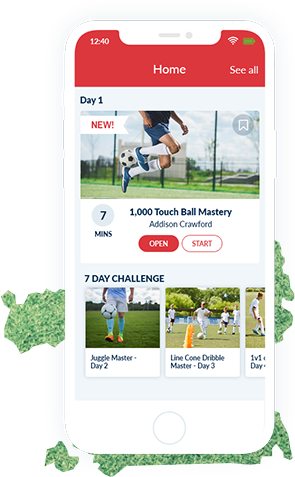
- Remember: you don't need to be a coach — follow-along videos do the coaching for you
Final Thoughts: Trust the Process
Every professional soccer player went through these same developmental stages. The ones who made it weren't necessarily the most talented at age 8 — they were the ones who consistently developed the right skills at the right time and never stopped working.
Your child's development journey is unique. Some kids rocket through certain stages. Others take longer. Both paths can lead to the same destination. What matters is that you're supporting age-appropriate development, encouraging daily practice, and keeping the game fun.
💡 Remember This:
A 10-year-old who does 15 minutes of ball mastery every day will be a fundamentally different player by age 14 than one who only trains at team practice. The gap compounds over time. The secret isn't talent — it's consistent, age-appropriate daily practice.
Start where your child is. Practice what matters at their age. Trust the process. The results will come.
Build Age-Appropriate Skills With Anytime Soccer Training
No matter what stage your player is at, daily home training accelerates development faster than anything else. That's exactly what Anytime Soccer Training is built for.
Here's what your player gets:
- 5,000+ follow-along videos organized by age, skill level, and skill type
- Ball mastery, dribbling, passing, shooting, and 1v1 moves — all on video
- Structured training plans so you never wonder "what should we work on today?"
- Progress tracking and leaderboards to keep your player motivated
- Works for every age from U6 to U18 — the platform grows with your child
You don't need to be a coach. Just hit play.
View Pricing & Start Free Trial Get Free Training PlanRelated Resources
📚 More Guides for Soccer Parents & Coaches
- 10 Ball Mastery Drills Your Child Can Do in 10 Minutes — Perfect for ages 6-12
- Free Soccer Drills for Kids — Start training at home today
- Complete Guide to U.S. Youth Soccer Structure — Understand the entire system
- The College Soccer Recruiting Process: Complete 2026 Guide — Start-to-finish recruiting roadmap
- Complete Guide to College Soccer Showcases — Top showcases by region
- Complete Guide to College Soccer ID Camps — Top ID camps by region
- Complete Guide to HBCU Soccer Programs — All 38 HBCU programs
- 10 Great College Soccer Programs You've Never Heard Of — Hidden gem schools
- Training Tips & Resources — All training content
- Parent Tips & Guides — Everything for soccer parents
About the Author: Neil Crawford is the founder of Anytime Soccer Training and host of The Inside Scoop podcast. As a soccer parent who personally trained his sons — one now at Charlotte FC Academy and the other in ECNL — Neil understands every stage of youth soccer development from the parent's perspective. He created Anytime Soccer Training so any parent could help their child improve at home, regardless of their own soccer background.