15-Minute Daily Soccer Routine for Kids Aged 6–12: No Time? Here's Your Solution
⚽ The Problem Every Busy Soccer Parent Faces
Your child needs consistent training to improve. But between homework, dinner, bedtime, and everything else on your plate, finding time feels impossible. Here's the truth most soccer parents don't realize: 15 minutes of focused, daily training beats 90 minutes of practice twice a week. Not because longer sessions aren't valuable—they are. But because consistency creates muscle memory, builds confidence, and develops skills faster than sporadic training ever could. This is the exact 15-minute system that's transforming kids from bench players to starters.
Part 1: Why Traditional Practice Schedules Leave Kids Behind
Team practices are essential, but they're not enough. Here's why your child is falling behind despite showing up to every practice:
📊 The Brutal Math of Team Practice:
- Limited touches on the ball: In a typical 90-minute team practice with 15 kids, your child might only have the ball at their feet for 10-15 minutes total. The rest is waiting, watching, or running without the ball.
- One-size-fits-all instruction: Coaches must address the entire team, not your child's specific development needs. That U10 player struggling with their weak foot? They're getting the same drills as everyone else.
- Gaps between sessions: Most youth teams practice 2-3 times per week. That means 4-5 days where skills aren't being reinforced—plenty of time for technique to regress.
Meanwhile, the kids who stand out at tryouts, make the competitive teams, and earn spots on academy rosters? They're not just relying on team practice. They're training at home, every single day.
But you don't have an hour. You don't have a massive backyard. And you definitely don't have the energy for complicated training plans after a long workday.
You need something simple, short, and effective.
Part 2: The 15-Minute Framework That Actually Works
This routine is built on three core principles that make it sustainable for busy families:
- Minimal equipment: One ball, a small space (10x10 feet works), and optional cones or markers
- Progressive skill development: Each week builds on the previous week's foundation
- Flexibility: Morning, after school, or before bed—it works whenever you can fit it in
The structure is deliberately simple: 3-minute warmup, 10 minutes of focused skill work, 2-minute cooldown. Same framework every day, different skills each week.
💡 Why 15 Minutes is the Magic Number:
Kids will fight a 60-minute training session. They won't fight 15 minutes. And 15 minutes of focused training beats 60 minutes of half-effort every time. Research shows that young players' attention spans max out around 15-20 minutes for skill development—beyond that, quality drops off a cliff. So we keep sessions tight, intense, and purposeful.
Part 3: Your Daily 15-Minute Breakdown
Minutes 0-3: Dynamic Warmup
Get the body moving and the mind focused. This isn't stretching—it's movement preparation that activates fast-twitch muscles and develops coordination.
| Time | Activity | Purpose |
|---|---|---|
| 0:00-0:30 | Light jogging in place or around small area | Raise heart rate, warm muscles |
| 0:30-1:00 | High knees (exaggerate the knee lift) | Hip flexor activation, coordination |
| 1:00-1:30 | Butt kicks (heels to glutes) | Hamstring engagement, running form |
| 1:30-2:00 | Side shuffles (both directions) | Lateral movement, agility prep |
| 2:00-2:30 | Light ball touches (tap side to side) | Get comfortable with ball |
| 2:30-3:00 | Dynamic movement (skips, lunges, arm circles) | Full body activation |
🎯 Pro Tip for Younger Kids (Ages 6-8):
Make the warmup fun! Turn it into a game—"Can you do high knees while I count to 20?" or "Show me your fastest side shuffle!" Kids this age respond better to challenges and games than to "exercises."
Minutes 3-13: Focused Skill Development (Rotates Weekly)
This is where the real growth happens. Ten minutes of deliberate practice on specific skills. The routine follows a 4-week rotation targeting the foundational skill areas every young player needs:
Week 1: Ball Mastery & Touch
Goal: Develop comfort and confidence with the ball at your feet
| Minutes | Drill | Focus | Resource |
|---|---|---|---|
| 3:00-5:00 | Foundation touches (inside/outside foot taps, sole rolls) | Get thousands of touches quickly | Ball Mastery Guide |
| 5:00-8:00 | Cone weave (5-6 cones, dribble through using both feet) | Control while changing direction | Free Drills Library |
| 8:00-11:00 | Box work (tight turns and direction changes in small square) | Close control in confined space | 7-Day Challenge |
| 11:00-13:00 | Speed dribbling (full speed for 20 feet, walk back, repeat) | Control at game speed | — |
Age Modifications:
Ages 6-8: Reduce cone count, increase spacing, focus on fun over perfection. Celebrate effort, not results.
Ages 9-12: Add complexity—alternate feet on every touch, increase speed requirements, reduce space between cones.
Week 2: Passing & Receiving
Goal: Build accuracy and consistency in passing technique
| Minutes | Drill | Focus |
|---|---|---|
| 3:00-6:00 | Wall passes (inside-of-foot technique against wall or rebounder) | Clean striking form |
| 6:00-9:00 | Target practice (hit targets from 10-15 feet—cones, shoes, chalk marks) | Accuracy over distance |
| 9:00-11:00 | First-touch control (toss ball, control with different surfaces) | Receiving under pressure |
| 11:00-13:00 | Partner passing OR self-passing drill (pass and receive on the move) | Game-like receiving |
"We focused on passing for one week—just 15 minutes a day. By Friday, my daughter's accuracy improved from maybe 40% to close to 70%. Her coach noticed immediately at Saturday's game."
Week 3: Shooting & Finishing
Goal: Develop power, accuracy, and confidence in front of goal
| Minutes | Drill | Focus |
|---|---|---|
| 3:00-5:00 | Stationary shooting (small goal or target, 10-12 shots on technique) | Lock ankle, strike through center |
| 5:00-8:00 | Dribble-and-shoot (dribble 10-15 feet, approach, shoot—alternate feet) | Shooting off the dribble |
| 8:00-11:00 | One-touch finishing (set ball up 2-3 feet away, approach and strike quickly) | Simulate game scenarios |
| 11:00-13:00 | Weak foot focus (all shots with non-dominant foot) | Develop both feet equally |
🎯 Setup Tip:
No goal? No problem. Use cones, chairs, or chalk marks to create a target. Garage doors work great as rebounders. Get creative with what you have—equipment doesn't matter nearly as much as repetition.
Week 4: Moves, Turns & 1v1 Skills
Goal: Learn to beat defenders and create space under pressure
| Minutes | Drill | Focus |
|---|---|---|
| 3:00-6:00 | Move repetition (step-over, scissors, Cruyff turn—practice 10 reps each) | Muscle memory for moves |
| 6:00-9:00 | Cone defender work (cones as "defenders," dribble and execute moves) | Beating pressure |
| 9:00-11:00 | Change of direction (sharp cuts, stop-and-go, acceleration bursts) | Explosive movement |
| 11:00-13:00 | Game-speed simulation (move + acceleration + finish at target) | Connect skills to scoring |
📈 Progression Note:
Start slow and controlled. As technique improves throughout the week, gradually add speed and pressure. By Day 7, your child should be executing moves at near-game speed.
Minutes 13-15: Active Cooldown
Don't skip this. The cooldown reinforces what was learned and prevents injury while keeping training fun.
| Time | Activity | Purpose |
|---|---|---|
| 13:00-14:00 | Light juggling or free play (keep it fun and loose) | Maintain ball feel, end on positive note |
| 14:00-15:00 | Static stretching (quads, hamstrings, calves—hold 15-20 seconds each) | Prevent injury, flexibility |
Total Time: 15 Minutes. Total Impact: Massive.
That's it. Three movements: warmup, skill work, cooldown. Fifteen minutes that will separate your child from 90% of their teammates who only show up to team practice.
Part 4: Your 30-Day Training Calendar (Print This Out)
Here's exactly what to do for the next 30 days. Print this calendar, stick it on the fridge, and check off each day as you complete it.
📅 The System:
Follow the 4-week rotation above. Each week focuses on one skill area. Repeat that week's 10-minute drill every day for 7 days before moving to the next skill. Same warmup and cooldown every day—only the middle 10 minutes changes weekly.
| Week | Focus Area | Daily Commitment | Expected Results |
|---|---|---|---|
| Days 1-7 | Ball Mastery & Touch | 15 min/day (Warmup + Skill + Cooldown) | Cleaner first touch, better dribbling control |
| Days 8-14 | Passing & Receiving | 15 min/day (Warmup + Skill + Cooldown) | Improved passing accuracy, confident receiving |
| Days 15-21 | Shooting & Finishing | 15 min/day (Warmup + Skill + Cooldown) | More power, better placement, scoring confidence |
| Days 22-28 | Moves, Turns & 1v1 Skills | 15 min/day (Warmup + Skill + Cooldown) | 3-4 reliable moves, beats defenders in games |
| Days 29-30 | Player's Choice (repeat favorite week) | 15 min/day | Reinforce strongest area or work on weakness |
✅ Calendar Success Tips:
- Same time, every day: Consistency builds habits. Pick a time and protect it like you protect dinner or bedtime.
- Track progress: Use a notebook or phone to record what your child struggles with and what clicks. Adjust accordingly.
- Celebrate streaks: 7 days in a row? That's worth celebrating. 14 days? Even better. Use small rewards to build momentum.
- Miss a day? No problem: Don't restart the calendar. Just pick up where you left off. Progress over perfection.
Part 5: Practical Implementation — Making This Work in Real Life
The routine is simple. But implementation? That's where most families struggle. Here's how to actually make this happen:
Equipment Checklist (Under $50 Total)
| Item | Cost | Why You Need It | Where to Get It |
|---|---|---|---|
| 1 Soccer Ball (size 3 for 6-8, size 4 for 9-12) | $20-30 | Foundation of everything | Amazon Link |
| 6-8 Training Cones or Markers | $10-15 | Dribbling courses, targets | Use shoes/water bottles if needed |
| Small Rebounder (Optional) | $30-50 | Wall passing without needing wall | Best Rebounders Guide |
| Pop-Up Goal (Optional) | $25-40 | Shooting target, motivation | Amazon Link |
💰 Cost Comparison:
This routine: $30-50 in equipment (one-time)
Private training: $200/month = $2,400/year
Result: Similar or better outcomes for 98% less money
Space Requirements
You don't need a full field. You don't even need a backyard. Here's what works:
- Driveway: 10x20 feet is plenty for most drills
- Garage: Perfect for ball mastery and wall passing (use foam ball if worried about walls)
- Basement: Foam ball for indoor training during bad weather
- Park or field: Ideal, but not required
- Backyard: Any size works—adjust cone spacing as needed
When to Schedule Training
The best time is whenever you'll actually do it. But here are proven schedules that work for real families:
| Time Slot | Why It Works | Best For |
|---|---|---|
| After School (3:30-3:45 PM) | Gets energy out before homework, becomes part of routine | Kids who need to move after sitting all day |
| Before Dinner (5:30-5:45 PM) | Breaks up homework and dinner, predictable window | Families with structured dinner times |
| After Dinner (6:30-6:45 PM) | Homework done, dinner digested, still time before bed | Night owls or families with late schedules |
| Weekend Mornings (9:00-9:15 AM) | Fresh energy, no time pressure, can extend if enjoying it | Busy weeknights—double up on weekends if needed |
Overcoming Common Obstacles
❌ "My child doesn't want to train"
Solution: Start with 5 minutes. Build the habit first, extend duration later. Make it non-negotiable but fun—think of it like brushing teeth, not a punishment. Use music, challenge them to beat yesterday's record, or train together. Most resistance disappears after week 2 when they start seeing results.
❌ "We don't have outdoor space"
Solution: Foam balls + basement = perfectly good training. Wall passing in garage. Driveway work. Soft touch drills in a small room. Creativity beats square footage every time.
❌ "I don't know enough about soccer to coach"
Solution: You're not coaching—you're facilitating. Follow this routine exactly. Film your child's form and compare to tutorial videos. Keep it simple and let the repetitions do the teaching. Most parents know less than you think.
❌ "We're too busy during the week"
Solution: Train 4 days instead of 7. Or do 10-minute versions. Or focus on weekends only (30 minutes Saturday + Sunday). Adjust the plan to fit your life—some training beats no training.
Part 6: What to Expect After 30 Days
If your child completes this 30-day routine consistently (even just 5-6 days per week), here's what you'll see:
📈 Technical Improvements:
- Noticeably better ball control—fewer heavy touches, more confidence dribbling
- Improved weak foot ability (if you emphasize it during drills)
- Sharper passing accuracy, especially over short distances
- Faster decision-making with the ball at their feet
- At least 2-3 reliable moves they can execute under pressure
🧠 Mental & Confidence Gains:
- More willing to take on defenders in games
- Less hesitation when receiving the ball
- Better understanding of their own strengths and areas to develop
- Pride in the discipline of daily training
⚽ Game Impact:
- Coaches and teammates notice the improvement
- More touches on the ball during games (because they're more comfortable seeking it out)
- Better performance in tryouts, evaluations, or competitive settings
"We did the 30-day plan. My son went from being invisible in rec games to scoring 3 goals in his last 4 games. His coach asked what changed. I showed him the calendar on our fridge with all the checkmarks. He couldn't believe it was that simple."
🎯 Real Talk:
Your child won't become Messi in 30 days. But they will improve. And if you continue this routine for 3 months, 6 months, a year? The compound effect is staggering. That's how kids go from recreational soccer to academy levels—not through expensive private coaching, but through consistent daily home training.
Part 7: Beyond 30 Days — What's Next?
The 30-day calendar is your foundation. Once you've completed it, you have options:
Option 1: Repeat the Cycle with Added Complexity
Run through the same 4-week rotation again, but increase difficulty:
- Increase speed on ball mastery drills
- Reduce target sizes for passing accuracy
- Add pressure (parent as light defender) to 1v1 skills
- Extend sessions to 20 minutes if time allows
Option 2: Focus on Weaknesses
Identify the skill area your child struggled with most. Spend 4-6 weeks drilling that specific area daily until it becomes a strength.
Option 3: Add Game-Specific Training
Once foundational skills are solid, introduce position-specific work—finishing for forwards, distribution for midfielders, positioning for defenders.
Option 4: Scale Up With Structured Programs
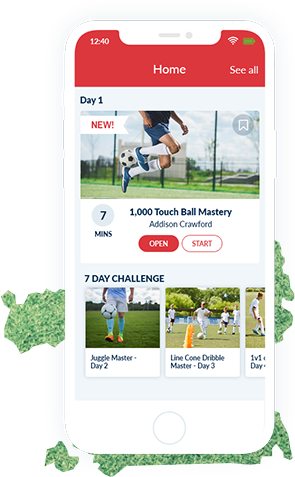
If your child is responding well to home training and you want more structure, consider programs like Anytime Soccer Training's follow-along video library, where you can access thousands of progressive drills organized by age and skill level.
Part 8: Success Stories — You're Not Alone
Thousands of families have used this exact 15-minute system to transform their child's development. Here are just a few:
Emma, Age 10 — From Bench Player to Starting Forward
"Emma sat on the bench her entire first club season. We started this 15-minute routine in January. By tryouts in March, she was a completely different player. Made the team as a starter and scored 8 goals this season. The coach said she's never seen improvement like that."
Carlos, Age 11 — From Cut to Club Team Starter
"Carlos got cut from club tryouts last year. Devastated us both. Found this routine, committed to 15 minutes every single day. Made the same team this year and he's starting. The transformation was all about consistency—we just showed up every day."
Sophia, Age 8 — From Scared to Confident
"Sophia was terrified of the ball. Would cry before games. After 6 weeks of this routine, she's a different kid. Asks for the ball. Takes on defenders. The confidence boost has carried over to school too. Best 15 minutes we spend all day."
📈 Common Thread Across All Success Stories:
- Time frame: 30-90 days to see major improvement
- Training frequency: 15 minutes, 5-6 days per week
- Parent involvement: Low skill requirement, high consistency requirement
- Equipment cost: Under $50 (ball + cones)
- Key factor: Structured plan + daily repetition = transformation
Part 9: A Final Note for Parents
You're not trying to replace team practice. You're not trying to become a professional coach. You're simply giving your child a competitive advantage through consistency and intentional practice.
Fifteen minutes per day is manageable. It's sustainable. And over time, it creates a gap between your child and the kids who only show up to team practice.
Will there be days you miss? Absolutely. Will your child complain sometimes? Probably. Will you question whether it's making a difference? Maybe.
But stick with it. Because here's what I've learned from training my own sons and working with thousands of families:
The kids who train at home—consistently, even when it's not fun, even when progress feels slow—are the ones who make the teams, earn the playing time, and develop a genuine love for the game.
Not because they have more talent. But because they put in more work.
Fifteen minutes. Every day. That's the difference.
Now go print that calendar, grab a ball, and get started.
Part 10: The Real-World Example — How My Sons Use This Exact System
I don't just teach this system—I live it. Both of my sons, Adam (Charlotte FC Academy) and Matthew (ECNL), use this exact 15-minute framework before every practice and game. Let me show you the math that changed everything for our family.
The Pre-Practice & Pre-Game Routine
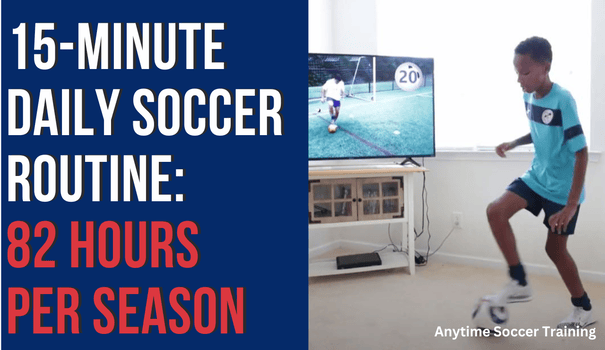
Before every team practice and every game, my sons spend 15-20 minutes doing Anytime Soccer Training follow-along videos. Not complicated. Not expensive. Just structured, focused touches on the ball before they step on the field with their team.
📊 The Compound Effect — Here's the Math:
Season length: 10 months
Training days per week: 5 days
Rest days: 20% (1 day off per week)
Active training days: 5 days × 4 weeks × 10 months × 80% = 160 days per season
Time per session: 15-20 minutes (let's use 17.5 min average)
Total additional training time per season: 160 days × 17.5 minutes = 2,800 minutes
That's 46.7 hours of extra ball touches per season.
While their teammates show up to practice cold, my sons have already accumulated nearly 47 additional hours of focused skill development over a 10-month season. That's like having 47 extra one-hour private training sessions—except it only cost 15 minutes before practices and games they were already attending.
"People ask me how Adam made Charlotte FC Academy and Matthew plays ECNL. They assume we hired expensive private trainers or that my sons are just 'gifted athletes.' The truth? They outworked everyone. Those 15 minutes before every practice and game—compounded over years—created a massive gap between them and kids who just showed up on time."
🎥 Watch: Pre-Practice Training in Action
This is what 15 minutes of pre-practice training looks like. Simple. Focused. Effective.
The After-School Wall Passing Routine
In addition to pre-practice training, my sons do two wall passing Anytime Soccer Training videos 3 times per week after school. These sessions are 10-12 minutes each, focusing on first touch, passing accuracy, and receiving under pressure.
📊 More Math — The After-School Addition:
Sessions per week: 3 days
Time per session: 20-24 minutes (two videos back-to-back)
Weeks per season: 40 weeks (10 months × 4 weeks)
Rest days: 20% (so 32 active weeks)
Total after-school wall passing time: 3 days × 22 minutes × 32 weeks = 2,112 minutes
That's an additional 35.2 hours per season just from after-school wall passing.
Combined totals:
Pre-practice/game training: 46.7 hours
After-school wall passing: 35.2 hours
Total additional training per season: 81.9 hours
My sons get nearly 82 extra hours of focused ball work per season compared to their teammates who only attend team practice. That's equivalent to 82 one-hour private training sessions—or about $8,200 worth of private coaching at $100/hour.
And it costs us $0 beyond the Anytime Soccer Training subscription.
🎥 Watch: Wall Passing After School
Simple wall passing drills done 3 times a week after school. Builds first touch and passing accuracy without needing a training partner.
You Don't Need a Full Field — Most Drills Work in Tiny Spaces
One of the biggest misconceptions about home training is that you need a massive backyard or access to a field. The truth? Most of these drills can be done inside your house with minimal space.
Ball mastery, first touch work, juggling, and even many dribbling drills require nothing more than a 6x6 foot area. My sons have done hundreds of training sessions in our garage, basement, and living room using a size 3 or foam ball.
✅ Indoor Training Benefits:
- Weather-proof: Rain, snow, heat—doesn't matter. Training happens regardless.
- Convenient: No setup time, no driving to a field, no excuses.
- Close control focus: Small spaces force tight touches and better ball control.
- Year-round consistency: Winter doesn't exist when you can train inside.
🎥 Watch: Training in a Tiny Space
You don't need a field. You don't even need a backyard. Just a small space and a ball.
"Parents ask me all the time: 'How do your sons get so many touches?' The answer is simple—they train in spaces other kids waste. Garage before practice. Living room after school. Driveway before games. Those 15-20 minute pockets add up to thousands of extra touches per month. That's the difference between good and great."
Get the Complete 30-Day Training Plan — 100% Free
Don't piece this together yourself. Get the exact system in a downloadable format with daily drills, video demonstrations, and progress trackers.
Your free download includes:
- Printable 30-day training calendar with checkboxes
- Day-by-day drill instructions with video links
- Weekly progress tracker (measure improvement)
- Equipment checklist and setup guide
- Parent coaching tips (zero soccer experience required)
- Troubleshooting guide for common obstacles
Want 5,000+ Follow-Along Training Videos?
This 15-minute routine is just the beginning. Anytime Soccer Training has everything you need to take your child from beginner to elite—all in one platform.
What you get:
- 5,000+ professional training videos (just hit play and train)
- Structured plans for every age group (U6-U18)
- Ball mastery, dribbling, shooting, passing, defending—everything
- Progress tracking and leaderboards
- Works on any device—backyard, garage, living room
- No coaching background required
Related Resources for Soccer Parents
📚 More Training Guides & Success Stories
- Soccer Development Milestones by Age — Know exactly what your child should be working on at every stage
- 10 Ball Mastery Drills in 10 Minutes — The foundation of this 15-minute system
- FREE 7-Day Ball Mastery Challenge — Start training today with a proven week-by-week plan
- 5 Best Soccer Rebounders for Home Training — Equipment recommendations
- Complete Guide to U.S. Youth Soccer Structure — Understand the path from rec to pro
- College Soccer Recruiting: Complete 2026 Guide — Plan ahead for the next level
About the Author: Neil Crawford is the founder of Anytime Soccer Training and host of The Inside Scoop podcast. As a soccer parent who personally trained his sons from recreational soccer to elite levels—one now at Charlotte FC Academy and the other in ECNL—Neil has lived the exact journey described in this article. He created Anytime Soccer Training so any parent can help their child develop world-class soccer skills at home, regardless of coaching background or budget. His mission: prove that consistent home training beats expensive private sessions every single time.