The College Soccer Recruiting Process: Where to Start (The Complete 2026 Guide)
January 6, 2026
✅ Navigate the College Soccer Recruiting Process
Navigate the college soccer recruiting process with confidence. Learn when to start, how to build your profile, contact coaches, and stand out—without breaking the bank on expensive training.
Introduction: You Don't Need to Be Elite to Play College Soccer
If you're reading this, you're likely a soccer parent wondering how your child can play at the next level. Maybe your son or daughter is passionate about soccer, shows promise, but you're overwhelmed by the recruiting process. You've probably heard conflicting advice: "Start recruiting freshman year!" or "Wait until junior year." You might be spending thousands on club fees, showcases, and private training, hoping it leads somewhere.
Here's what most parents don't realize: the college soccer recruiting process is more accessible than you think, and it doesn't require elite status or unlimited funds. As someone who guided my son to a professional academy using home training methods, I've learned that strategic preparation beats expensive shortcuts every time.
This guide will walk you through exactly where to start, what matters most, and how to build a recruiting strategy that works for your family's budget and timeline. Even better, with consistent home training using quality drills that take just minutes per day, your child can develop the technical skills college coaches actually want to see.
Related:
The Definitive Guide to In-home Soccer Training (Free Download)
Understanding the College Soccer Landscape
The Division Breakdown: Where Does Your Child Fit?
| Division | Programs | Scholarships |
|---|---|---|
| NCAA D1 | ~330 programs | 9.9 (men) / 14 (women) |
| Level: Highest | Best For: Elite players, national/international recruiting | ||
| NCAA D2 | ~220 programs | 9.0 (men) / 9.9 (women) |
| Level: High | Best For: Strong players seeking balance of academics/athletics | ||
| NCAA D3 | ~450 programs | None (academic aid available) |
| Level: Moderate to High | Best For: Student-athletes prioritizing education | ||
| NAIA | ~200 programs | 12 scholarships per team |
| Level: Moderate | Best For: Late bloomers, flexible recruiting timelines | ||
| NJCAA | ~500+ programs | 18 scholarships per team |
| Level: Varies | Best For: Academic improvement, pathway to 4-year schools | ||
💡 The Reality Check
With approximately 1,700+ NCAA soccer programs and roughly 13,000 roster spots opening annually due to graduation, there IS opportunity. However, with hundreds of thousands of youth soccer players nationwide, only about 7-8% of high school players will play at the NCAA level.
The key isn't being the best player in your state—it's finding the RIGHT level where you can contribute, develop, and thrive.
The Numbers You Need to Know: NCAA Participation Reality
Before investing thousands in showcases and elite clubs, understand exactly what you're competing for. These official NCAA statistics reveal the true landscape of college soccer recruiting.
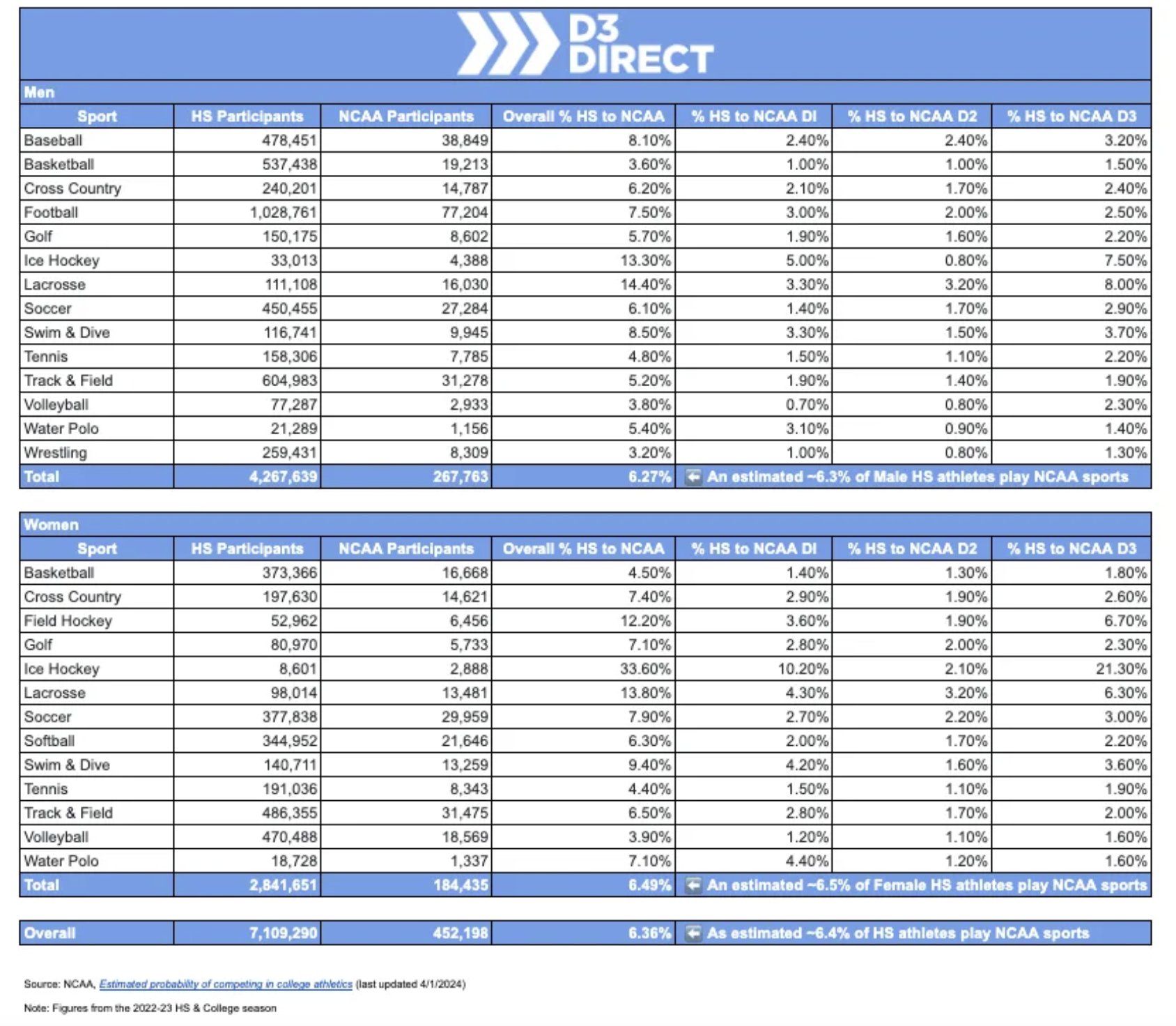
Understanding the College Soccer Numbers: The data above reveals a sobering reality that many families overlook when investing thousands of dollars annually in elite youth soccer. Of the 450,445 boys playing high school soccer, only 27,294 (6.1%) will go on to play NCAA soccer at any level—and that includes Division I, II, and III combined. For girls, the numbers are slightly better but still challenging: 29,958 out of 377,838 high school players (7.9%) continue to the NCAA level.
Breaking it down further, only 1.4% of boys and 2.7% of girls make it to Division I programs—the ones most families are aiming for when they spend $8K-$15K per year on elite clubs. Even more critical: these percentages represent making a roster, not receiving scholarship money. The vast majority of college soccer players receive partial scholarships or none at all, making the return on investment for most families significantly lower than expected.
This reality check doesn't mean you shouldn't pursue competitive soccer, but it does mean you should be strategic about how much you invest and realistic about the probable outcomes. Focus on skill development first, strategic exposure second.
⚠️ What These Numbers Mean for Your Family
- Boys Soccer: 450,445 high school players → 27,294 NCAA players (6.1%) → Only 1.4% reach Division I
- Girls Soccer: 377,838 high school players → 29,958 NCAA players (7.9%) → Only 2.7% reach Division I
- The Math: If you're spending $10K/year on elite clubs for 5 years ($50K total), and your child has a ~6-8% chance of ANY NCAA roster spot (not scholarship), are you making a sound investment?
- Better Strategy: Develop elite technical skills through affordable home training, play at appropriate competitive level, target strategic showcases when ready
Scholarship Reality: What You Actually Need to Know
| Scholarship Facts | Men's Soccer | Women's Soccer |
|---|---|---|
| NCAA D1 Scholarships per Team | 9.9 (equivalency) | 14 (equivalency) |
| Average Roster Size | 28-32 players | 26-30 players |
| Players Receiving Athletic Aid | ~60-70% | ~70-80% |
| Full Ride Scholarships | Very rare (1-2 players) | Uncommon (3-5 players) |
| Average Scholarship Amount | 30-40% of costs | 40-50% of costs |
| Likelihood of ANY Scholarship | ~2% of HS players | ~3% of HS players |
⚠️ The Math Parents Need to Understand
A D1 men's team with 9.9 scholarships and 30 players means the average player receives 0.33 scholarships (33% of costs). If college costs $60,000/year, that's $40,000 you're still paying annually.
Meanwhile, a strong student with a 3.8 GPA might receive 50-75% academic scholarship at a D3 school, making it cheaper than a partial athletic scholarship at D1.
Bottom line: Don't chase athletic scholarships alone. Build academic credentials that open doors to merit-based aid.
When to Start the Recruiting Process
The Year-by-Year Timeline
| Grade | Primary Focus | Recruiting Actions | Skill Development |
|---|---|---|---|
| Freshman (Ages 14-15) |
Foundation Building |
• Research college programs casually • Begin documenting highlights • Understand NCAA eligibility |
• Train 3-4x weekly with 10-minute ball mastery drills • Focus on first touch and control • Build core strength |
| Sophomore (Ages 15-16) |
Profile Creation |
• Create recruiting email/profile • Build initial highlight footage • Take PSAT • Attend 1-2 ID camps (spring) |
• Increase training intensity • Work on weak foot • Develop position-specific skills • Track progress monthly |
| Junior (Ages 16-17) |
ACTIVE RECRUITING |
• Send recruiting packages (Sept-Oct) • Take SAT/ACT (fall & spring) • Attend targeted ID camps • Campus visits • Monthly coach updates |
• Fine-tune technical skills • Build match fitness • Study game film • Master position-specific movements |
| Senior (Ages 17-18) |
Finalization |
• Official visits (fall) • Compare scholarship offers • Sign NLI (Nov or Apr) • Maintain coach relationships |
• Maintain peak fitness • Prepare for college-level play • Keep skills sharp • Stay injury-free |
✅ Can You Start Later?
Absolutely. While junior year is prime recruiting time, players commit during senior year, gap years, and from junior colleges regularly. Late bloomers exist in every recruiting class.
The key is having demonstrable skills on video and academic credentials when you do start reaching out. Skills developed through consistent home training—even if you started late—can be showcased effectively in highlight videos.
The Highlight Video: Your Make-or-Break Recruiting Tool
Best Practices for College Recruiting Highlight Videos
Your highlight video is often your ONLY chance to showcase ability. A well-made 4-minute video can open doors. A poorly made 10-minute video gets skipped entirely.
Video Specifications & Technical Requirements
| Element | Requirement | Why It Matters |
|---|---|---|
| Length | 3-5 minutes MAXIMUM (3-4 is ideal) |
Coaches watch 20+ videos daily. They'll skip long ones or fast-forward through filler. |
| Video Quality | 1080p minimum Stable footage (no shaky camera) |
Poor quality = looks unprofessional and makes it hard to evaluate skills |
| File Format | MP4 uploaded to YouTube or Hudl | Coaches won't download files. YouTube "unlisted" links are standard. |
| Opening Slate | 5-7 seconds showing: • Name • Position • Grad year • Email & phone • Jersey number (optional) |
If video gets shared, coaches can contact you directly |
| Camera Angle | Side view from stands (shows full field width) |
Lets coaches see positioning, field awareness, and decision-making |
What to Include: The 20-30 Clip Formula
| Clip Category | Number of Clips |
|---|---|
| Best 5-7 Plays (Opening) | 5-7 clips (first 60 seconds) |
| What Coaches Look For: Your absolute best moments—goals, assists, defensive stops, key passes. Hook them immediately. | |
| Technical Skills | 6-8 clips |
| What Coaches Look For: First touch under pressure • Dribbling in traffic • Passing accuracy (short & long) • Ball control with both feet • Turning with the ball | |
| Tactical Awareness | 4-6 clips |
| What Coaches Look For: Reading the game (positioning) • Creating space off-ball • Defensive shape and transitions • Vision and decision-making | |
| Physical/Athletic | 3-5 clips |
| What Coaches Look For: Speed in transition • Winning 50/50 balls • Strength on the ball • Endurance/work rate | |
| Position-Specific | 4-6 clips |
|
What Coaches Look For: Forwards: Finishing, movement off ball Midfielders: Distribution, box-to-box play Defenders: 1v1 defending, clearances Goalkeepers: Shot-stopping, distribution |
|
Pro Tips for Maximum Impact
🎥 Advanced Highlight Video Strategies
1Front-load your best clips: Coaches decide in the first 60 seconds if they'll keep watching. Put your top 5-7 plays first.
2Show both feet: Include clips demonstrating ability with both feet. One-footed players are a red flag.
3Trim to action: Start clips 2-3 seconds before the play, end 1-2 seconds after. No one wants to watch you receive a throw-in for 10 seconds.
4Competitive games only: Rec league blowouts don't count. Show you can perform against quality opponents.
5Update every 3-4 months: Your skills improve. Your video should reflect current ability, especially after working through structured training programs.
6Get coaching feedback first: Before sending to colleges, have your club or high school coach review it. They know what coaches look for.
7Make it easy to share: YouTube unlisted link can be forwarded by coaches to recruiting coordinators. Private videos can't.
Highlight Video Checklist
- Video is 3-5 minutes maximum
- Opening slate includes name, position, grad year, contact info
- Best 5-7 clips are in the first 60 seconds
- 20-30 total clips showing variety of skills
- All footage is from competitive games (not practice)
- Footage is less than 6 months old
- 1080p quality, stable camera angles
- Clips are trimmed to action (no long setup or follow-through)
- Both feet are demonstrated
- Position-specific skills are highlighted
- Uploaded to YouTube as "unlisted" or to Hudl
- Minimal music/effects (or none)
- Jersey number is visible in most clips
- Coach has reviewed and approved
Creating Your Recruiting Profile
Essential Components
| Section | What to Include |
|---|---|
| Personal Info |
• Full name • Graduation year • Email & phone • Height & weight • Primary & secondary positions |
| 💡 Pro Tip: Use professional email (firstname.lastname@email.com) | |
| Academic Info |
• Current GPA (weighted & unweighted) • SAT/ACT scores • Class rank (if favorable) • Intended major |
| 💡 Pro Tip: Update scores after each test. Only list GPA if 3.0+ | |
| Soccer Info |
• Club team & coach contact • High school team & coach • Position(s) played • Years of experience |
| 💡 Pro Tip: Verify coach emails are current | |
| Highlight Video |
• YouTube or Hudl link • 3-5 minutes max • Recent footage (within 6 months) |
| 💡 Pro Tip: Make video "unlisted" not private. Update every 3-4 months | |
| Honors/Awards |
• All-conference selections • Team awards • Academic honors • Leadership positions |
| 💡 Pro Tip: List most recent/impressive first | |
Complete Recruiting Action Plan
Freshman Year Action Plan
| Priority | Action Items | Timeline |
|---|---|---|
| Academic |
• Meet with school counselor • Confirm taking NCAA core courses • Target 3.5+ GPA • Build strong study habits |
September |
| Skills Development |
• Establish 4x weekly training routine • Master fundamental ball mastery drills • Focus on weak foot development • Work on first touch consistency |
Ongoing |
| Video Collection |
• Ask parents to film games • Save best clips monthly • Create organized video folder |
October onwards |
| Research |
• Watch college soccer on TV/streaming • Identify 3-5 "dream schools" • Learn different division levels |
Throughout year |
Sophomore Year Action Plan
| Priority | Action Items | Timeline |
|---|---|---|
| Academic |
• Take PSAT (October) • Maintain 3.5+ GPA • Continue core courses • Consider SAT/ACT prep (spring) |
Full year |
| Profile Creation |
• Draft recruiting email/profile • Create professional email address • Collect coach contact information • Get professional headshot photo |
January-March |
| Video |
• Create first highlight video • Upload to YouTube (unlisted) • Get coach feedback on video • Continue filming games |
February-April |
| Research & Outreach |
• Build target list of 20-30 schools • Research programs thoroughly • Send initial inquiry emails (spring) • Consider 1-2 ID camps (spring/summer) |
March-June |
| Skills |
• Increase training to 4-5x weekly • Add position-specific work • Document progress with structured drill progressions • Film quarterly skill assessment |
Ongoing |
Junior Year Action Plan (CRITICAL YEAR)
| Priority | Action Items | Timeline |
|---|---|---|
| Academic |
• Take SAT/ACT (August or October) • Retake if needed (December or March) • Register with NCAA Eligibility Center • Maintain strong GPA |
August-March |
| Active Recruiting |
• Send recruiting packages to 20-30 schools • Follow up every 4-6 weeks • Respond to ALL coach emails within 24hrs • Update coaches monthly with achievements |
September-April |
| Video Updates |
• Update highlight video (fall) • Create final junior year video (spring) • Share new videos with coaches • Ensure video shows recent improvement |
October & March |
| Campus Visits |
• Attend 2-4 ID camps at top choices • Make unofficial campus visits • Tour facilities, meet coaches • Attend games at target schools |
Throughout year |
| Evaluation |
• Narrow school list to top 10-15 • Assess realistic fit for each • Understand scholarship possibilities • Identify backup options |
January-April |
Senior Year Action Plan
| Priority | Action Items | Timeline |
|---|---|---|
| Official Visits |
• Schedule 3-5 official visits (max allowed) • Prepare questions for coaches/players • Evaluate fit: athletic, academic, social • Thank coaches afterward |
September-November |
| Decision Making |
• Compare scholarship offers • Calculate total cost of attendance • Discuss options with family • Consider academic fit and major |
October-November |
| Commitment |
• Make verbal commitment • Sign National Letter of Intent • Complete financial aid forms • Inform other coaches of decision |
November (early) or April (regular) |
| Academic Finish |
• Maintain GPA (offers can be rescinded!) • Complete NCAA Eligibility Center process • Graduate on time • Take any remaining required courses |
Full year |
| Preparation |
• Continue training at high level • Stay injury-free • Connect with future teammates • Prepare mentally for college soccer |
Full year |
Common Recruiting Mistakes to Avoid
| Mistake | Why It's Harmful | How to Avoid It |
|---|---|---|
| 1. Waiting Too Long | Most competitive recruiting happens junior year. Starting senior year means competing for leftover spots. | Begin skill development freshman year, create profile sophomore year, actively recruit junior year |
| 2. Only Pursuing D1 | D1 is 19% of programs. Ignoring D2/D3/NAIA eliminates 81% of opportunities. | Research all levels. Cast wide net initially. Find programs where you'd START, not just make the roster. |
| 3. Neglecting Academics | 2.8 GPA eliminates 70% of programs and most academic scholarships. | Prioritize grades from day one. Academic money often exceeds athletic scholarships. |
| 4. Poor Communication | Typos, late responses, unprofessional emails destroy opportunities instantly. | Proofread everything. Respond within 24 hours. Use professional language always. |
| 5. Letting Club Coach Handle Everything | Club coaches have 20+ players. They can't give individual recruiting attention. | Drive your own process. Use coach as resource, not as recruiting coordinator. |
| 6. Overspending on Exposure | $20,000 on showcases without skills to back it up wastes money. | Develop player first through consistent home training, showcase second |
The Bottom Line
You don't need to spend $15,000-25,000 annually on private training, showcases, and elite clubs to play college soccer. You need:
- Genuine technical skills developed through consistent training
- Strong academic credentials that open financial aid opportunities
- Professional recruiting materials showcasing your ability
- Strategic, persistent communication with appropriate programs
- Realistic self-assessment and willingness to find the right fit
As a parent who guided my son to a professional academy using home training methods, I can tell you: skills development beats expensive shortcuts every single time. If you focus on fundamentals, train purposefully 4-5 times per week, maintain strong academics, and approach recruiting strategically, your child CAN play college soccer at a level matching their ability and goals.
The opportunity is there. The path is clear. Now it's time to take action.
Essential Equipment
Here's the basic gear you need for home training and recruiting prep. These are affiliate links—they don't cost you extra but help support this site.
- Soccer Ball – Size 4 (ages 8-12) or Size 5 (13+)
- Flat Cones – For marking training areas and creating highlight videos
- Pop-up Goals – Essential for shooting footage
- Rebounder – For first touch and passing practice
- Bluetooth Speaker – For follow-along training videos
Ready to Build the Skills College Coaches Want?
The foundation of successful recruiting is undeniable technical ability. If your child needs structured, professional training they can do at home—without the $10,000+ annual price tag of private coaching—Anytime Soccer Training provides:
- 5,000+ follow-along training videos covering every skill level and position
- Professional curriculum designed by experienced coaches
- Affordable team and individual subscriptions ($6/player annually for teams)
- Progress tracking to document improvement for recruiting videos
- Position-specific training matching college-level expectations
Stop spending thousands on showcases before your child has the skills to compete. Build the foundation first with proven training methods.
Start Your Free Trial Download Free 30-Day Training Plan
📚 Related Resources
- 10 Ball Mastery Drills Your Child Can Do in 10 Minutes - Build fundamental skills fast
- Pro Tips for College Showcase Weekends from Seasoned Coaches - Maximize your ID camp results
- Free Soccer Drills for Kids - Start training today with proven exercises