The Complete Guide to In-Home Soccer Training: How to Accelerate Your Child's Development (2026)
How busy parents can help their kids develop elite soccer skills at home—even with limited time, space, or soccer experience. Includes equipment guide, sample schedule, 5 ready-to-use drills, and a free training plan.
⚽ The Busy Parent's Dilemma
If you're anything like me, your weeknights probably look something like this: racing home from work, throwing dinner together, and trying to remember who has soccer practice, piano lessons, and homework due tomorrow. It's a lot. And somewhere in the middle of the chaos, you're trying to help your kid grow, improve, and stay excited about soccer—not just for the wins, but for the confidence, discipline, and joy it brings. That's exactly why I've become a big believer in in-home soccer training.
What You'll Learn in This Guide:
- Why home training accelerates development (backed by science)
- The exact equipment you need (and what you don't)
- A sample weekly training schedule you can copy
- 5 drills you can start today with just a ball
- How to keep your child motivated long-term
- Expected results timeline (week by week)
- Common questions answered
Why In-Home Soccer Training Works (The Science Behind It)
After years of helping my own sons develop their skills at home (one now plays at Charlotte FC Academy), I can tell you this: the players who train at home consistently outpace those who only practice with their team.
Here's something I didn't expect to learn on this journey:
Soccer doesn't just build strong legs—it builds strong brains.
When kids repeat the same moves over and over (like toe taps or dribbling through cones), they're training their brains to work faster and more efficiently. Every touch on the ball exercises their coordination, memory, and decision-making.

And here's the key insight: short, focused practices in a low-stress environment actually help kids learn better than chaotic team practices where they might only touch the ball a few times.
📊 The Numbers Don't Lie:
| Metric | Team Practice Only | Team + Home Training |
|---|---|---|
| Touches Needed for Mastery | 10,000+ | 10,000+ |
| Touches Per Team Practice | 20-50 | 20-50 |
| Touches Per 15-Min Home Session | 0 | 500+ |
| Weekly Touches (3x practice only) | 60-150 | — |
| Weekly Touches (3x practice + 4x home) | — | 2,060-2,150 |
| Weeks to 10,000 Touches | 67-167 weeks | 5-6 weeks |
⚡ Action Step #1:
Calculate how many touches your child gets per week currently. If it's under 1,000, home training can fill the gap. Understanding the complete U.S. youth soccer structure helps you see where your child fits and what level of training they need.
For more comprehensive strategies, download our Definitive Guide to In-Home Soccer Training (free).
5 Reasons We Started Training at Home (And Haven't Looked Back)
1. It Fits Any Schedule
No commute. No weather cancellations. Your child trains when it works—before school, after dinner, or during a study break. This flexibility is especially valuable for families navigating expensive club soccer costs who want to maximize development without additional travel expenses.
⚡ Action Step #2:
Look at your weekly calendar right now. Identify three 15-minute windows where training could happen. Write them down.
2. It's Budget-Friendly
You don't need a turf field or pro-level gear. We started with a ball, some cones, and a patch of space in the garage. Compare this to club soccer costs that can range from $800 to $12,000+ annually depending on your location.
⚡ Action Step #3:
Before buying anything, do one session with just a ball and household items (socks as cones, garage door as goal).
3. It Builds Confidence Fast
My son used to hang back in games. After just two weeks of home drills, he started taking more chances—and scoring goals. The balance between fun and skill development is key to building this confidence.
⚡ Action Step #4:
Pick ONE skill your child struggles with (weak foot, first touch, etc.) and focus your first week of training on that skill alone. Check our 10-minute ball mastery drills for specific exercises.
4. It Strengthens Your Bond
Now we've got this little routine together. Sometimes I pass with them, sometimes I just watch. But I'm involved—and they love that.
⚡ Action Step #5:
Commit to being present (not on your phone) for at least the first 5 minutes of each session.
5. It Creates Lasting Habits
The discipline of regular practice transfers to school, relationships, and life. You're not just building a soccer player—you're building character.
⚡ Action Step #6:
Use a visual tracker (sticker chart, whiteboard, or app) so your child can see their consistency build over time.
Essential In-Home Soccer Training Equipment
I suggest starting with budget-friendly equipment. You can always upgrade once your child proves they're committed.
Starter Kit (Under $50)
| Basic Equipment to Get Started | ||
|---|---|---|
| Item | Purpose | Link |
| Soccer Ball | Size 4 (ages 8-12) or Size 5 (13+). Essential for every drill. | Buy Now → |
| Flat Cones (20-pack) | For dribbling courses, boundaries, and marking spaces. | Buy Now → |
| Pop-up Goals (Set of 2) | For finishing targets, 1v1 games, and shooting practice. | Buy Now → |
Level-Up Kit ($50-150)
| Advanced Equipment for Progression | ||
|---|---|---|
| Item | Purpose | Link |
| Agility Ladder | Develops footwork, speed, and coordination. | Buy Now → |
| Soccer Rebounder | First touch, passing accuracy, wall passing practice. | Buy Now → |
| Bluetooth Speaker | Follow along with video training sessions. | Buy Now → |
💡 Pro Tip:
Add a plywood board from your local hardware store behind your rebounder for extra width and stability. If you're on a tight budget, socks for cones and a garage door as a goal work just fine.
⚡ Action Step #7:
Start with the Starter Kit only. Add one piece of equipment per month as your child demonstrates consistency.
Take Training Up A Level: The A-Champs Interactive Rebounder
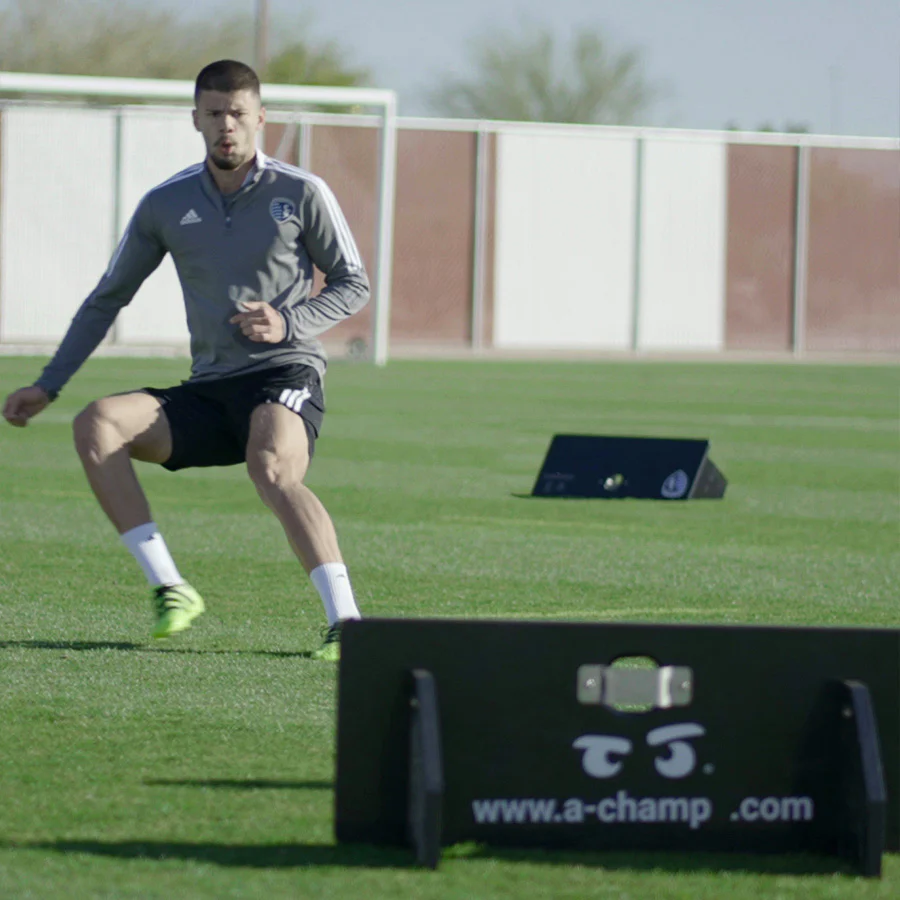
If you're ready to simulate game-like pressure, the A-Champs Rebounder has built-in lights and sensors that challenge touch, reaction time, and decision-making in real time.
I'm getting one for my son because he plays midfield, where scanning, first touch, and reaction are crucial. With its lights and sensors, this rebounder makes training more game-like and engaging. Read our full soccer rebounders comparison review to see how it compares to other options.
Sample Weekly In-Home Soccer Training Schedule
Here's the exact schedule that helped my son improve. Total commitment: 2-3 hours of additional training per week.
| Day | When | Focus | Duration |
|---|---|---|---|
| Monday | Before practice | Ball mastery - Toe taps, sole rolls, foundation touches | 15 min |
| Tuesday | After school | Dribbling - Cone weaves, tight space control, speed work | 15 min |
| Wednesday | — | Rest or free play (no structured training) | — |
| Thursday | Before practice | Juggling + weak foot development | 15 min |
| Friday | — | Rest (game day preparation) | — |
| Saturday | Before game | Shooting warm-up - Finishing, technique, confidence | 20 min |
| Sunday | Off-day session | Full training - Comprehensive skill work, games, fun drills | 45-60 min |
⚡ Action Step #8:
Copy this schedule and adjust it to fit your family's rhythm. Post it somewhere visible. For additional drill ideas, check out our 101 free YouTube training videos organized by age group.
5 In-Home Soccer Drills to Start Today
You can do all of these in a small space with just a ball and cones. These drills are featured in our free soccer drills library.
Toe Taps (Ball Mastery)
| Drill Setup | |
|---|---|
| Time | 2 minutes |
| Equipment | Soccer ball only |
| Space Needed | 2x2 feet |
| Goal | 60+ taps in 30 seconds |
| How to Execute | |
|---|---|
| 1 | Place ball in front of you |
| 2 | Alternate tapping the top of ball with each foot |
| 3 | Keep your eyes up, not on the ball |
| 4 | Count your taps in 30 seconds, then try to beat your score |
Cone Weave (Dribbling)
| Drill Setup | |
|---|---|
| Time | 5 minutes |
| Equipment | 5 cones, soccer ball |
| Setup | Place 5 cones in a line, 2 feet apart |
| Goal | Complete 10 rounds without hitting a cone |
| Progression Steps | |
|---|---|
| 1 | Dribble through cones using inside of feet only |
| 2 | Return using outside of feet only |
| 3 | Repeat using weak foot only |
| 4 | Time yourself and try to improve each round |
Wall Passes (First Touch)
| Drill Setup | |
|---|---|
| Time | 5 minutes |
| Equipment | Soccer ball, wall or garage door |
| Distance | Start 5-10 feet from wall |
| Goal | 50 passes without losing control |
| How to Execute | |
|---|---|
| 1 | Stand 5-10 feet from wall |
| 2 | Pass with right foot, receive with left |
| 3 | Pass with left foot, receive with right |
| 4 | Gradually increase speed and distance from wall |
Juggling Progression
| Drill Setup | |
|---|---|
| Time | 5 minutes |
| Equipment | Soccer ball, 4 cones (optional) |
| Space | 6x6 foot square |
| Goal | 10 consecutive juggles without leaving the square |
| Progression Steps | |
|---|---|
| 1 | Start with ball in hands, drop and kick back up, catch |
| 2 | Progress to 2 touches before catching |
| 3 | Work toward 5, then 10, then 20 consecutive juggles |
| 4 | Practice with 4-cone perimeter to develop control in tight space |
1v1 With Parent
| Drill Setup | |
|---|---|
| Time | 5-10 minutes |
| Equipment | Soccer ball, 2 small goals (or markers) |
| Field Size | 15 feet between goals |
| Goal | Have fun and build confidence through play |
| How to Play | |
|---|---|
| 1 | Set up two small goals 15 feet apart |
| 2 | Play 1v1 with your child |
| 3 | Let them win sometimes, challenge them other times |
| 4 | Focus on encouraging creativity, risk-taking, and joy |
⚡ Action Step #9:
Do Drills 1-3 today. They require zero equipment beyond a ball and take less than 15 minutes total. For more drill ideas, explore our complete free drills library.
🎯 Free Training Plan for Soccer Parents
If you want a done-for-you plan, I created a free training plan that's helped thousands of families get started.
✅ What's Included in the Free Training Plan:
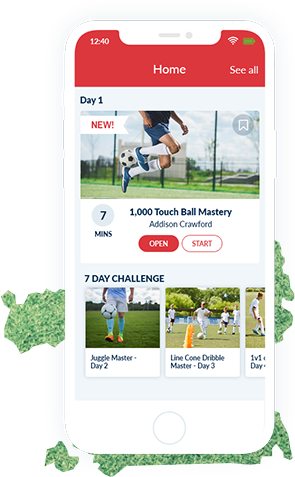
- Daily 15-minute video drills (just press play and follow along)
- Mix of dribbling, ball control, passing, and agility work
- Built-in progress tracker so your child can see improvement
- Super simple instructions (works even if you've never played soccer)
- Age-appropriate progressions from beginner to advanced
This is exactly what got us started—and it's still part of our weekly routine. My child actually asks to train now.
What to Expect: Results Timeline
Here's what I've seen with my own kids and the families in our community:
| Timeframe | What You'll Notice |
|---|---|
| Week 1 | Your child gets comfortable with the routine. Initial resistance may occur. |
| Week 2-3 | First touch and ball control improve noticeably. Child starts requesting practice. |
| Month 1 | Confidence on the field increases. More touches in games. Less hesitation. |
| Month 2-3 | Coaches and teammates notice the improvement. Child earns more playing time. |
| Month 6+ | Skills become automatic; your child stands out from peers who only practice with team. |
Want to see how home training fits into the bigger picture? Check out our guide on balancing fun and skill development to ensure training stays enjoyable.
💬 Real Talk: What I've Noticed Since We Started
- My kid's first touch is dramatically better
- Their confidence on the field has skyrocketed
- They actually love the alone time with the ball—no pressure, no comparison
- As a parent, I feel like I'm part of their journey instead of just driving them to practice
- We've saved thousands on private coaching ($100/hour → $120/year for unlimited training)
"We saw more growth in one week of short home practices than an entire month of team training." – Yes, that came out of my mouth, and I stand by it.
Common Questions About In-Home Soccer Training
Q: Do I need soccer experience to help my child train?
A: No. Use follow-along videos (like Anytime Soccer Training) where your child follows a coach on screen. Your job is to encourage and be present, not to coach.
Q: How much space do I need?
A: A 10x10 foot area works for most drills. A garage, basement, driveway, or small backyard is plenty. Even a hallway can work for some ball mastery drills.
Q: Will this replace team practice?
A: No—and it shouldn't. Home training supplements team practice by adding the repetitions kids need to truly develop skills. Understanding your child's place in the soccer structure helps you balance both.
Q: What if my child resists practicing at home?
A: Start with games (1v1, racing, shooting). Sandwich structured training between fun activities. Keep sessions short (10-15 minutes). Read our guide on keeping training fun for specific strategies.
Q: How often should we train?
A: 3-5 times per week for 15 minutes is ideal. Consistency beats intensity. Four 15-minute sessions provide more benefit than one 60-minute marathon session.
Q: What age should we start home training?
A: As young as 5-6 years old with playful drills. By age 8-10, kids can handle more structured training. Teenagers benefit from focused weak-foot and position-specific work.
Your Action Plan (Start Today)
Here's exactly what to do after reading this guide:
| When | Action Item | Done? |
|---|---|---|
| Today | Identify 3 training time slots in your weekly schedule | ☐ |
| Do the Toe Taps drill for 2 minutes with your child | ☐ | |
| Join the Free Training Plan | ☐ | |
| This Week | Complete Days 1-3 of the free training plan | ☐ |
| Order basic equipment (ball + cones) if you don't have them | ☐ | |
| Set up a visual progress tracker (sticker chart or whiteboard) | ☐ | |
| This Month | Establish a consistent weekly training routine | ☐ |
| Add one new drill per week from the free training library | ☐ | |
| Celebrate your child's progress (no matter how small) | ☐ |
Final Thoughts: The Future of Youth Soccer Development
Look, I'm not saying in-home training replaces team practice. But when you add 10–15 minutes of focused work at home? That's where the real development happens. The touches. The confidence. The habits.
And best of all? You don't need to be a coach. You just need to be a supporter.
So if you've been feeling stuck or overwhelmed, give the training plan a shot. Set up a tiny space. Make it fun. Be consistent.
Your kid is capable of so much—and it might just start in your living room.
The players who train at home consistently outpace those who only practice with their team. It's not about talent—it's about touches.
Ready to Accelerate Your Child's Development?
Join thousands of families who've transformed their child's soccer journey with structured home training.
Anytime Soccer Training provides:
- 5,000+ follow-along training videos organized by age and skill level
- Replaces expensive private coaching ($100/hour → $120/year)
- Works in any space (garage, driveway, backyard, basement)
- Team option: $6/player/year | Individual: $120/year
- Free 7-day trial with no credit card required
Start with the free training plan, then upgrade when you're ready for unlimited access.
Start Free Training Plan View Full Program PricingRelated Resources
📚 More Parent Training & Development Guides
- The Definitive Guide to In-Home Soccer Training - Free comprehensive download
- Balancing Fun and Skill Development - Keep training enjoyable
- 10 Ball Mastery Drills (10 Minutes) - Quick daily drills
- Free Soccer Drills for Kids - Complete drill library
- 101 Free YouTube Training Videos by Age Group - Organized video library
- Best Soccer Rebounders 2025 - Equipment comparison
- Most Expensive Cities for Club Soccer - Cost comparison and savings strategies
- Complete Guide to U.S. Youth Soccer Structure - Understanding the system
About the Author: Neil Crawford is a soccer dad and founder of Anytime Soccer Training, a platform with 5,000+ follow-along training videos for youth players. His son now plays at Charlotte FC Academy after years of dedicated home training combined with club soccer. Neil proves that any parent can make a massive difference in their child's development—regardless of their own soccer experience or budget.